Private Label Nutraceutical Manufacturers | MGVS Lifesciences
Partner with MGVS Lifesciences for private label nutraceutical manufacturing, custom formulations, quality production, and compliant packaging.
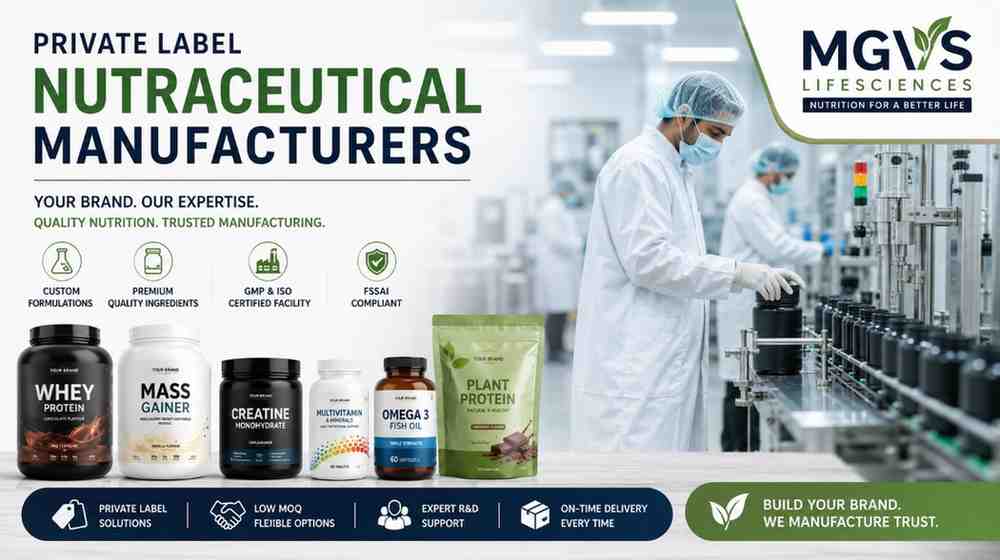
Why More Brands Are Choosing Private Label Nutraceutical Manufacturers Instead of Building Their Own Factory
Launching a nutraceutical brand has become much more accessible than it was a decade ago. Earlier, businesses that wanted to sell protein powders, multivitamins, herbal supplements, or sports nutrition products had to invest heavily in manufacturing infrastructure, production equipment, quality testing laboratories, and regulatory approvals. For most startups and growing businesses, that level of investment simply wasn't practical.
This is one of the biggest reasons why private label nutraceutical manufacturers have become the preferred choice for entrepreneurs, healthcare professionals, gym owners, pharmacies, wellness brands, and distributors across India. Instead of spending crores on setting up a manufacturing unit, businesses can work with an experienced manufacturing partner that already has certified facilities, trained technical teams, quality systems, and production capabilities.
A private label manufacturing model allows brands to focus on areas that directly contribute to business growth, such as branding, customer acquisition, product education, online sales, and distribution, while the manufacturing partner takes care of production, quality assurance, packaging, and regulatory compliance.
From practical experience, many first-time supplement brands assume that manufacturing is the most difficult part of the business. In reality, maintaining consistent product quality, ensuring every batch meets specifications, managing raw material procurement, and complying with FSSAI regulations require continuous expertise. These are responsibilities that experienced private label nutraceutical manufacturers handle every day.
Another major advantage is speed. Establishing a manufacturing facility can take many months or even years after considering approvals, machinery installation, staff recruitment, validation, and commercial production. A private label manufacturing partner significantly reduces the time required to bring products to market, allowing businesses to launch much faster and respond to changing consumer demand.
Cost efficiency is another important factor. Manufacturing equipment, laboratory testing instruments, warehouse facilities, and production staff involve ongoing expenses even before the first product is sold. By partnering with reliable private label nutraceutical manufacturers, businesses convert these fixed investments into manageable manufacturing costs without compromising on product quality.
Many successful Indian supplement brands actually began with private label manufacturing before expanding into larger product portfolios. Some continue using the same manufacturing model even after achieving nationwide distribution because it allows them to remain flexible, introduce new products quickly, and scale production without making massive capital investments.
Of course, choosing the right manufacturing partner is equally important. A low manufacturing price may look attractive initially, but poor quality control, inconsistent formulations, delayed deliveries, or weak regulatory compliance can damage a brand's reputation much faster than expected. Selecting an experienced manufacturer with transparent processes, certified facilities, and a strong quality culture often proves to be a better long-term business decision.
For businesses looking to build a trusted supplement brand, working with an experienced company like MGVS Lifesciences provides access to manufacturing expertise, regulatory knowledge, private label solutions, and scalable production capabilities without the challenges of operating an independent manufacturing facility.
What Do Private Label Nutraceutical Manufacturers Actually Handle from Idea to Finished Product?
Many people believe that a manufacturer simply mixes ingredients, fills bottles, and ships finished products. In reality, experienced private label nutraceutical manufacturers are involved in almost every stage of product development, long before commercial production begins.
The process usually starts with understanding the client's business goals. Some brands want ready-to-launch formulations that can reach the market quickly, while others require completely customised products designed for a specific customer segment such as athletes, women, senior citizens, children, or general wellness consumers.
Once the product strategy is finalised, formulation experts work on selecting suitable ingredients based on functionality, stability, dosage, compatibility, taste, and regulatory requirements. This stage becomes particularly important for products like whey protein, plant protein, pre-workout supplements, collagen blends, multivitamins, herbal capsules, gummies, and immunity formulations where ingredient interaction directly affects product quality.
Raw material sourcing is another responsibility handled by reliable manufacturers. Ingredients are procured from approved suppliers and undergo quality checks before entering production. Depending on the formulation, manufacturers may source proteins, amino acids, botanical extracts, vitamins, minerals, probiotics, enzymes, or speciality nutraceutical ingredients from domestic as well as international suppliers.
Quality testing continues throughout the manufacturing process. Every batch is monitored for identity, purity, microbiological safety, and other critical quality parameters to ensure consistency. Certified manufacturing facilities also follow Good Manufacturing Practices, maintain proper documentation, and implement quality control systems that support regulatory compliance.
Packaging is another area where private label nutraceutical manufacturers add significant value. Businesses can choose from jars, bottles, pouches, sachets, stick packs, blister packs, or cartons depending on the product category and target market. Packaging is not only about appearance but also about protecting the product from moisture, oxygen, light, and contamination throughout its shelf life.
Label development is equally important because every nutraceutical product must comply with FSSAI labelling requirements. Incorrect declarations, missing mandatory information, or unsupported health claims can delay product approvals or create compliance issues later.
I still remember seeing cartons stacked in a warehouse during peak summer. The products were perfectly manufactured, but improper storage by the distributor affected packaging quality. Manufacturing does not end when the product leaves the production line. Proper warehousing, transportation, and inventory handling remain equally important.
Before dispatch, finished products undergo final inspections, documentation, and batch release procedures. Manufacturers also assist clients with production records, certificates, and supporting documents whenever required, especially for institutional buyers or export enquiries.
Companies like MGVS Lifesciences support businesses throughout this journey by combining formulation expertise, certified manufacturing infrastructure, quality assurance systems, packaging support, and private label manufacturing services under one roof. This integrated approach helps brands move from an initial product idea to a market-ready supplement with greater confidence and efficiency.
Which Nutraceutical Products Can You Launch Through a Private Label Manufacturing Partner?
One of the biggest advantages of working with experienced private label nutraceutical manufacturers is the flexibility to build a product portfolio that matches your target audience and business model. Whether you are launching a new wellness brand or expanding an existing healthcare business, private label manufacturing allows you to introduce multiple supplement categories without investing in production infrastructure.
Sports nutrition remains one of the fastest-growing segments in India. Gym owners, fitness coaches, online supplement retailers, and sports nutrition startups frequently launch products such as whey protein, plant protein, mass gainers, pre-workout supplements, BCAA formulations, creatine, electrolyte blends, and post-workout recovery products under their own brand names. An experienced manufacturing partner can offer both ready-to-market formulations and customised recipes based on nutritional goals and flavour preferences.
Daily wellness supplements also continue to see strong demand. Multivitamins, multimineral tablets, calcium supplements, vitamin D3, vitamin C, zinc, magnesium, omega fatty acids, probiotics, digestive enzymes, liver support formulations, immunity blends, and antioxidant supplements are commonly developed through private label nutraceutical manufacturers for pharmacies, healthcare clinics, and wellness brands.
Ayurvedic nutraceuticals have created another significant opportunity. Many businesses are introducing herbal capsules, powders, tablets, and syrups formulated with ingredients such as Ashwagandha, Giloy, Shatavari, Brahmi, Turmeric, Moringa, and other traditional botanicals while ensuring compliance with applicable regulatory standards.
Doctor-branded supplements have also become increasingly popular. Many healthcare professionals now develop specialised nutritional products for women's health, bone health, pregnancy nutrition, diabetic nutrition, cardiac wellness, liver care, children's nutrition, and geriatric support. Private label manufacturing allows these products to be launched with professionally developed formulations and compliant packaging.
Businesses can also introduce supplements in different dosage formats depending on customer preference. Capsules, tablets, powders, effervescent tablets, oral liquids, sachets, gummies, softgels, and stick packs all serve different market needs. Selecting the right format often depends on product stability, consumer convenience, pricing, and brand positioning.
Some businesses begin with just one flagship product, while others launch an entire range together. There is no single approach that works for everyone. What matters is selecting products that align with your market strategy and partnering with experienced private label nutraceutical manufacturers who can maintain consistent quality as your business grows.
Manufacturers like MGVS Lifesciences support a wide range of product categories through private label manufacturing, including protein powders, sports nutrition supplements, capsules, tablets, liquid nutraceuticals, herbal formulations, and customised wellness products. This allows businesses to expand their product portfolio over time while maintaining consistency in quality, packaging, and manufacturing standards.
How to Evaluate Quality Standards, Certifications, and Regulatory Compliance Before Finalising a Manufacturer
When comparing private label nutraceutical manufacturers, pricing often gets the most attention. Yet experienced brand owners usually spend more time reviewing quality systems than negotiating manufacturing charges. A nutraceutical product carries your brand name, not the manufacturer's. If quality issues arise, customers remember your brand first.
One of the first things to verify is whether the manufacturing facility follows Good Manufacturing Practices (GMP) and operates under recognised quality management systems such as ISO certification. These standards indicate that the company has documented processes for production, hygiene, quality control, equipment maintenance, and batch traceability.
FSSAI compliance is equally important. Every nutraceutical product manufactured and sold in India must comply with applicable FSSAI regulations regarding ingredients, dosage limits, labelling requirements, and manufacturing practices. A manufacturer should be able to guide clients on regulatory requirements instead of leaving them to figure everything out independently.
Raw material quality deserves equal attention. Reliable manufacturers source ingredients only from approved suppliers and verify them through incoming quality checks before production begins. Proteins, botanical extracts, vitamins, minerals, amino acids, probiotics, and speciality ingredients should all meet predefined quality parameters.
Laboratory testing is another area where businesses should ask detailed questions. Manufacturers should conduct appropriate testing for identity, purity, microbiological safety, heavy metals where applicable, and batch consistency before products are released for sale.
Documentation also reflects how professionally a manufacturing unit operates. Batch manufacturing records, certificates of analysis, stability information where required, and production documentation become valuable not only for compliance but also when supplying institutional buyers or export markets.
I might be wrong here, but this does not apply to every manufacturer. Some smaller facilities genuinely maintain excellent quality despite having limited production capacity. The important point is to verify processes rather than making assumptions based only on factory size.
Visiting the manufacturing facility can reveal details that brochures never mention. Clean production areas, organised raw material storage, calibrated equipment, trained staff, proper gowning practices, and systematic documentation usually indicate a company that takes quality seriously.
Experienced private label nutraceutical manufacturers understand that regulatory compliance is not simply paperwork. It protects both the brand owner and the end consumer while reducing the risk of costly product recalls or compliance issues later.
Understanding Custom Formulations, Ready to Launch Products, Packaging, and Branding Options
Every nutraceutical business begins differently. Some entrepreneurs already have a product idea backed by market research, while others simply know the customer segment they want to serve. A good manufacturing partner should be able to support both situations.
Ready to launch formulations are often the quickest option. These are established formulations that have already been developed and can be manufactured under your own brand with customised packaging and labelling. This approach is popular among first-time businesses because it reduces product development time and helps them enter the market faster.
Custom formulations are more suitable for brands that want something unique. You may wish to combine specific ingredients, create a specialised sports nutrition blend, develop sugar-free products, improve solubility, or introduce a flavour that competitors do not offer. This process usually involves formulation development, sample preparation, product evaluation, stability considerations, and multiple rounds of feedback before commercial production begins.
Flavour development deserves more attention than many people realise. A protein powder with excellent nutritional value may still struggle if the taste or texture disappoints customers. I have seen businesses spend months refining chocolate and coffee flavours because even small differences influence repeat purchases.
Packaging decisions also affect product performance and customer perception. Jars remain popular for protein powders, while capsules and tablets are commonly packed in bottles or blister packs. Sachets and stick packs work well for travel-friendly products, and liquid nutraceuticals often require bottles that provide adequate protection during transportation.
Branding extends beyond a good-looking label. Product information must be accurate, readable, and compliant with FSSAI requirements. Unsupported claims, incorrect nutritional declarations, or missing mandatory information can delay product launches and create unnecessary complications.
Some businesses focus heavily on packaging aesthetics while overlooking practical aspects like moisture protection or transport durability. Attractive packaging certainly helps on store shelves and online marketplaces, but it should also protect product quality throughout its shelf life.
Experienced private label nutraceutical manufacturers support clients throughout formulation development, packaging selection, artwork coordination, and regulatory labelling so the finished product is both market ready and compliant.
What Affects MOQ, Manufacturing Cost, Production Timelines, and Overall Profitability?
Almost every discussion with private label nutraceutical manufacturers eventually reaches the same question.
"What is your MOQ?"
Minimum Order Quantity certainly matters because it directly influences investment requirements and inventory planning. Lower MOQs make it easier for startups to test the market before committing to larger production volumes. Larger orders, however, often improve manufacturing efficiency and reduce the cost per unit.
Manufacturing cost depends on much more than product quantity. Ingredient quality, imported raw materials, speciality botanical extracts, branded ingredients, flavour systems, packaging material, dosage form, testing requirements, and custom formulation work all contribute to the final cost.
Packaging alone can significantly influence pricing. Premium jars, printed cartons, induction sealing, measuring scoops, shrink sleeves, and premium label finishes increase production costs but may strengthen brand positioning in competitive markets.
Lead time is another factor that businesses sometimes underestimate. Production scheduling, procurement of specialised ingredients, artwork approval, packaging availability, laboratory testing, and dispatch planning all influence delivery timelines. During periods of high demand, production slots may need to be booked well in advance.
Earlier, we discussed how MOQ is an important factor while selecting a manufacturer. That remains true. But after watching several supplement brands grow, I have realised that quality often becomes more valuable than simply choosing the lowest MOQ. Saving a small amount during manufacturing rarely compensates for customer complaints or inconsistent product performance.
Sometimes clients negotiate ₹20 per kg while ignoring ingredient quality, and that decision becomes expensive later.
Businesses should also account for warehousing, shipping costs, inventory holding, and distributor margins while calculating profitability. Manufacturing cost is only one component of the overall business equation.
Planning production realistically with experienced private label nutraceutical manufacturers helps businesses avoid stock shortages, delayed launches, and unnecessary financial pressure as they scale.
Common Mistakes Businesses Make While Selecting Private Label Nutraceutical Manufacturers
Many businesses invest considerable effort in creating logos, websites, and marketing campaigns, yet spend only a few hours selecting their manufacturing partner. Unfortunately, that decision often shapes the future of the brand more than any advertising campaign.
One common mistake is selecting a manufacturer based only on the lowest quotation. Lower pricing can sometimes reflect efficient operations, but in other situations it may indicate compromises in raw material quality, testing procedures, packaging standards, or production support.
Another issue is failing to verify manufacturing certifications and regulatory compliance. Businesses should request information about manufacturing standards, quality systems, testing protocols, and facility capabilities before placing commercial orders.
Some entrepreneurs also ignore product sampling. Approving samples allows businesses to evaluate taste, texture, appearance, packaging quality, and customer acceptance before full-scale production begins. Skipping this stage can result in expensive corrections later.
MOQ confusion creates problems as well. Businesses occasionally order more inventory than they can realistically sell, tying up valuable working capital. Others order quantities that are too small and quickly face stock shortages after initial market success.
Label compliance is another area where mistakes occur frequently. Incorrect nutritional information, unsupported claims, missing declarations, or design errors may delay product launches even after manufacturing is complete.
I still remember seeing cartons stacked in a warehouse during peak summer. The manufacturing quality was excellent, but poor storage conditions affected the packaging before products reached retailers.
And then everyone started asking who made the product.
Choosing experienced private label nutraceutical manufacturers means looking beyond pricing and considering technical expertise, communication, production planning, quality consistency, and long-term business support.
Why MGVS Lifesciences Is a Trusted Partner for Private Label Nutraceutical Manufacturing in India
Building a successful supplement brand requires much more than manufacturing capacity. Businesses need a partner that understands product development, regulatory expectations, quality assurance, commercial production, and the practical challenges of launching products in competitive markets.
This is where MGVS Lifesciences brings valuable industry experience.
The company supports businesses across multiple nutraceutical categories, including protein powder manufacturing, whey protein manufacturing, sports nutrition supplements, mass gainers, pre-workout supplements, creatine, tablets, capsules, liquid nutraceuticals, herbal formulations, and custom nutritional products. Whether a client requires a ready-to-market formulation or a customised product developed for a specific audience, the focus remains on quality, consistency, and regulatory compliance.
MGVS Lifesciences also assists clients with formulation support, packaging selection, private label manufacturing, contract manufacturing, and third party manufacturing, allowing businesses to work with a single manufacturing partner throughout their product journey.
Quality remains central to every manufacturing stage. From carefully sourced raw materials and controlled production processes to quality testing and compliant packaging, each step is designed to support reliable product performance and long-term brand credibility.
The team also understands that every client has different business goals. A startup introducing its first protein powder may require lower initial production volumes and additional guidance, while an established distributor may prioritise production scalability, documentation, and supply consistency. Manufacturing support should adapt to these differences rather than follow a standard process for every customer.
Brands also benefit from working with a manufacturer that values open communication. Timely production updates, realistic delivery schedules, technical guidance, and transparent discussions about formulation or packaging help prevent misunderstandings that often delay product launches.
In the nutraceutical industry, long-term partnerships are usually built on consistency rather than promises. Businesses that choose experienced private label nutraceutical manufacturers often stay with the same partner for years because reliable manufacturing becomes one of the strongest foundations for sustainable brand growth. MGVS Lifesciences works to become that dependable manufacturing partner for businesses across India that are looking to build trusted nutraceutical brands.
Questions Every Brand Owner Should Ask Before Signing a Private Label Manufacturing Agreement
Before signing an agreement with private label nutraceutical manufacturers, it is worth slowing down and asking a few practical questions. A manufacturing partnership often lasts for years, so clarity at the beginning can prevent expensive misunderstandings later.
Ask how raw materials are sourced and whether they come from approved suppliers. Good manufacturers should be transparent about their procurement process and quality checks without revealing confidential supplier information.
Understand exactly what is included in the quoted price. Does it cover formulation support, packaging, testing, labelling, or only manufacturing? Many businesses compare quotations without realising they are comparing completely different service packages.
Discuss production timelines in detail. Ask how long product development, artwork approval, manufacturing, testing, and dispatch typically take. A realistic timeline is always more valuable than an overly optimistic promise.
Clarify the Minimum Order Quantity for different products. Protein powders, capsules, tablets, gummies, and liquid supplements may all have different production requirements. Knowing this helps you plan inventory and cash flow more effectively.
It is also important to understand who is responsible for label compliance. Some private label nutraceutical manufacturers guide clients throughout the process, while others expect businesses to submit print-ready artwork that already complies with regulatory requirements.
If you are planning future expansion, ask whether the manufacturer can scale production as your business grows. Switching manufacturers after establishing your brand can be time-consuming and may require product redevelopment.
Businesses targeting exports should also enquire about documentation, product registrations, and certifications required for international markets. Export requirements vary from one country to another, so early planning avoids delays later.
Finally, ask about communication. It sounds simple, but regular updates, quick responses, and technical support often determine whether a manufacturing partnership runs smoothly.
Choosing a manufacturer should never feel like buying a commodity. You are selecting the company that will manufacture products carrying your brand name. Taking the time to ask these questions usually leads to better long-term decisions.
Frequently Asked Questions About Private Label Nutraceutical Manufacturers
1. What do private label nutraceutical manufacturers do?
Private label nutraceutical manufacturers produce dietary supplements that are sold under another company's brand name. They may also provide formulation support, manufacturing, packaging, labelling, quality testing, and regulatory guidance depending on the services offered.
2. Is private label manufacturing suitable for startups?
Yes. It is one of the most practical options for startups because it eliminates the need to invest in manufacturing infrastructure, production equipment, laboratories, and regulatory approvals. Businesses can focus on branding and sales while an experienced manufacturing partner manages production.
3. Can I customise my supplement formulation?
Absolutely. Many manufacturers offer both ready-to-launch formulations and customised product development. Businesses can modify ingredients, dosage, flavours, packaging, and product formats based on their target audience and market positioning.
4. What certifications should I check before choosing a manufacturer?
Look for manufacturers operating under recognised quality systems such as GMP and ISO certifications. They should also comply with FSSAI regulations and follow documented quality control procedures throughout manufacturing.
5. What products can be manufactured through private label services?
Most private label nutraceutical manufacturers offer protein powders, whey protein, mass gainers, creatine, pre-workout supplements, multivitamins, herbal supplements, capsules, tablets, gummies, liquid nutraceuticals, immunity products, probiotics, and sports nutrition formulations.
6. How is the manufacturing cost calculated?
Manufacturing cost depends on several factors including raw material quality, formulation complexity, packaging type, product format, order quantity, testing requirements, and production volume. Premium ingredients and customised formulations generally increase production costs.
7. How long does private label manufacturing usually take?
The timeline varies depending on formulation development, packaging availability, artwork approval, laboratory testing, and production schedules. Ready-to-launch products are generally completed faster than fully customised formulations.
8. Why should I choose MGVS Lifesciences for private label nutraceutical manufacturing?
MGVS Lifesciences supports businesses with private label manufacturing, custom formulations, contract manufacturing, and third party manufacturing across a wide range of nutraceutical products. The company combines manufacturing expertise, quality-focused production, regulatory understanding, and flexible solutions to help startups, healthcare professionals, wellness brands, distributors, and established businesses launch reliable nutraceutical products with confidence.
Before you finalise any manufacturing partner, ask yourself one simple question.
If your product becomes successful and demand doubles within a year, will your manufacturer be ready to grow with you?
That answer often matters more than the quotation sitting on your desk today.