Top Best Third Party Manufacturer in paonta sahib
Looking for a trusted Third Party Manufacturer in Paonta Sahib? MGVS Lifesciences offers quality nutraceutical manufacturing solutions.
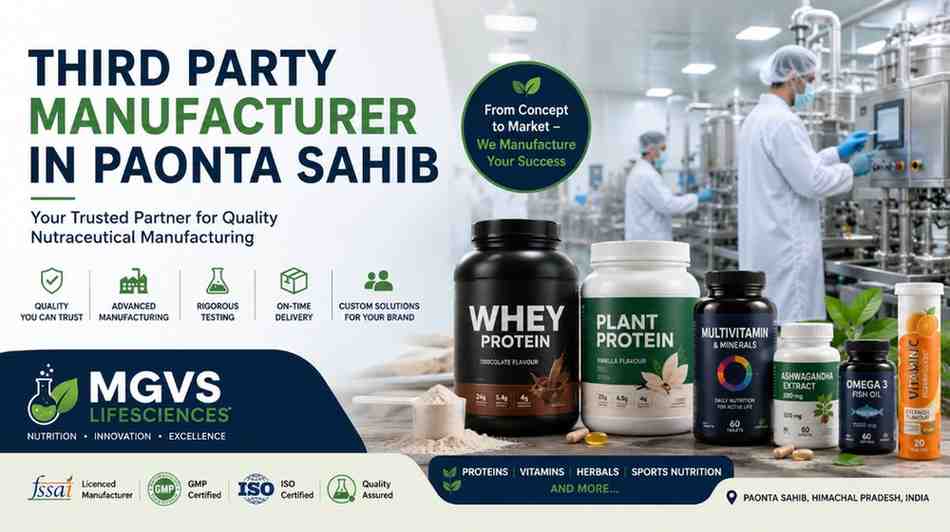
If you are searching for a Third Party Manufacturer in Paonta Sahib, chances are you are planning to launch a supplement brand or expand your existing product range without setting up a manufacturing facility. This is where the location of your manufacturing partner becomes more important than many first-time entrepreneurs realise.
Over the last few years, Paonta Sahib has earned a strong reputation as one of North India's leading manufacturing destinations for nutraceuticals, pharmaceuticals, herbal products, and dietary supplements. The region offers a combination of industrial infrastructure, skilled manpower, reliable logistics, and an ecosystem built around regulated manufacturing. For businesses looking for a dependable Third Party Manufacturer in Paonta Sahib, these advantages often translate into smoother production, better quality control, and faster product launches.
Another reason many brands prefer working with a Third Party Manufacturer in Paonta Sahib is the easy availability of raw materials and packaging suppliers. Whether you are manufacturing whey protein, multivitamin tablets, collagen powder, herbal capsules, or immunity boosters, sourcing becomes more efficient when suppliers and manufacturers operate within the same industrial network. This often reduces procurement delays and helps maintain consistent production schedules.
Location also plays a practical role in distribution. Paonta Sahib is well connected to major markets across North India, making transportation easier for businesses supplying products to distributors, pharmacies, gyms, healthcare professionals, and online marketplaces. For brands planning nationwide expansion, shorter transit times can improve inventory management and reduce logistics costs.
The manufacturing ecosystem has also matured over the years. Many facilities follow Good Manufacturing Practices, maintain modern quality control laboratories, and operate under recognised certifications such as FSSAI, GMP, and ISO standards. While every manufacturer operates differently, businesses generally find that working with an experienced Third Party Manufacturer in Paonta Sahib provides greater confidence during product development, regulatory documentation, and commercial production.
I still remember visiting a warehouse during one of the busiest summer months. Cartons were stacked neatly, waiting for dispatch to different states, while quality teams continued checking finished batches before loading. It reminded me that manufacturing is not just about producing supplements. Storage, documentation, packaging, and dispatch all contribute to the final quality that reaches customers.
For startups, choosing the right location can save months of unnecessary coordination. Instead of managing multiple vendors across different cities, many businesses prefer partnering with an experienced manufacturer that can coordinate formulation, production, packaging, labelling, and dispatch under one roof. Companies like MGVS Lifesciences work closely with brands at different stages of growth, helping simplify the manufacturing journey while maintaining quality and regulatory compliance.
What Does a Third Party Manufacturer in Paonta Sahib Actually Do for Your Brand?
Many people assume that a Third Party Manufacturer in Paonta Sahib simply produces products according to a formula and ships them out. In reality, the scope of third party manufacturing is much broader. A capable manufacturing partner becomes an extension of your business, handling several critical activities that directly influence your product quality and brand reputation.
The process often begins with understanding your business goals. Some clients already have a finished formulation, while others only have a product idea. An experienced manufacturer helps evaluate ingredients, dosage, flavour options, packaging formats, regulatory requirements, and production feasibility before manufacturing begins.
Suppose a gym owner wants to launch a whey protein brand. Manufacturing the protein powder is only one part of the project. The business also needs flavour development, nutritional calculations, label compliance, packaging selection, batch testing, and commercial production planning. Working with an established Third Party Manufacturer in Paonta Sahib allows these activities to be coordinated efficiently instead of dealing with separate vendors for every stage.
Many healthcare professionals launching doctor-branded supplements face a similar situation. They may know exactly what health concern they want to address but require technical support for formulation development, ingredient compatibility, stability considerations, and regulatory documentation. This is where experienced manufacturers add significant value beyond simple production.
Quality control remains one of the most important responsibilities. Reliable manufacturers inspect incoming raw materials, monitor production at different stages, conduct laboratory testing, and verify finished products before dispatch. These checks help maintain consistency from one batch to the next, which is essential for building long-term customer trust.
Packaging support is another area that is often underestimated. Choosing between jars, stand-up pouches, bottles, blister packs, or sachets affects product protection, transportation, storage, and customer perception. Even seemingly small decisions, such as induction sealing or moisture protection, can influence shelf life.
I might be wrong here, but this does not apply to every manufacturer. Some only provide manufacturing, while others offer complete private label support that includes formulation assistance, packaging guidance, documentation, and logistics coordination. Understanding this difference before signing an agreement can prevent unnecessary delays later.
Many businesses initially focus only on finding the lowest quotation. Pricing certainly matters because it affects profitability. At the same time, selecting a manufacturing partner based solely on cost may create challenges if quality systems, documentation, or production planning are weak. Sometimes clients negotiate ₹20 per kilogram while overlooking product consistency, and that decision becomes expensive after market complaints begin arriving.
This is one reason businesses increasingly prefer working with experienced companies like MGVS Lifesciences, where manufacturing is supported by technical expertise, quality processes, and practical guidance throughout product development.
From Product Idea to Market Launch, How the Manufacturing Journey Really Works
Launching a supplement brand looks straightforward from the outside. Select a product, design a label, manufacture it, and start selling. The reality is usually more detailed than that.
The journey normally starts with identifying the product category. Some businesses choose sports nutrition products like whey protein, mass gainers, creatine, or pre-workout supplements. Others focus on daily wellness products such as multivitamins, calcium tablets, herbal capsules, probiotics, collagen, or immunity formulations.
Once the product concept is finalised, the formulation stage begins. Ingredient selection is carefully evaluated for compatibility, dosage, functionality, taste, and intended market positioning. If flavoured powders are involved, multiple flavour trials may be required before reaching commercial approval. Chocolate may sound simple until one sample tastes too bitter, another becomes overly sweet, and the third finally meets expectations.
After the formulation is approved, packaging decisions are made. Brands choose container sizes, labels, scoops, cartons, shrink sleeves, induction seals, and outer shipping boxes. Label artwork is also reviewed to ensure mandatory declarations comply with applicable FSSAI regulations.
Production planning follows. Raw materials are sourced, inspected, and released for manufacturing only after quality verification. Throughout manufacturing, quality teams monitor blending, filling, sealing, coding, and packing operations. Finished batches undergo laboratory testing before dispatch.
MOQ often becomes an important discussion during this stage because startups usually want smaller production quantities to reduce investment. That is understandable. At the same time, there are situations where product quality, reliable ingredients, and stable manufacturing processes deserve greater attention than simply finding the smallest MOQ. A slightly higher production quantity with better consistency may support stronger long-term brand growth.
One issue many first-time entrepreneurs overlook is production scheduling. Manufacturing units operate according to planned production calendars. Delays in label approval, packaging material arrival, or regulatory documentation can shift dispatch timelines. We have seen brands complete formulation approval quickly but lose valuable weeks because printed containers arrived late.
Then comes dispatch, warehouse handling, and transportation. Products must be packed securely to withstand movement across different climatic conditions. I still remember seeing cartons stacked in a warehouse during peak summer. It made me realise how much careful storage conditions matter before products even reach distributors.
An experienced Third Party Manufacturer in Paonta Sahib helps coordinate these moving parts so that businesses spend less time managing operational challenges and more time building their brand. Manufacturers like MGVS Lifesciences support this journey through formulation assistance, quality-focused production, compliant manufacturing practices, packaging guidance, and timely coordination, helping businesses bring nutraceutical products to market with greater confidence.
Products You Can Manufacture Through a Third Party Manufacturer in Paonta Sahib
One of the biggest advantages of working with an experienced Third Party Manufacturer in Paonta Sahib is the flexibility to build a complete product portfolio instead of launching just one supplement. Many successful brands begin with a single product such as whey protein or multivitamins and gradually expand into sports nutrition, wellness, immunity, weight management, and daily health categories as demand grows.
The actual product range depends on the manufacturing capabilities of your partner, available certifications, formulation expertise, and production infrastructure. This is why it is worth discussing your long term plans before finalising a manufacturing agreement. A manufacturer that supports multiple dosage forms can save you from switching vendors every time you add a new product.
Some of the most commonly manufactured nutraceutical products include:
Product Category
Popular Products
Sports Nutrition
Whey Protein, Mass Gainers, Creatine, BCAA, Pre Workout, Post Workout Recovery Supplements
Protein Supplements
Plant Protein, Vegan Protein, Casein Protein, Meal Replacement Powders
Daily Wellness
Multivitamins, Multiminerals, Calcium, Vitamin D3, Vitamin C, Zinc
Herbal Supplements
Ashwagandha, Shilajit, Giloy, Tulsi, Brahmi, Turmeric Extract
Immunity Products
Herbal Immunity Blends, Effervescent Tablets, Gummies, Capsules
Women's Health
PCOS Support, Prenatal Vitamins, Calcium Supplements, Iron Formulations
Men's Wellness
Testosterone Support, Energy Formulas, Performance Supplements
Weight Management
Fat Burners, Fibre Supplements, Detox Products
Digestive Health
Probiotics, Prebiotics, Digestive Enzymes
Children's Nutrition
Gummies, Syrups, Chewable Tablets, Nutrition Powders
Apart from selecting the product category, brands can also choose different dosage forms depending on their target audience.
These may include capsules, tablets, powder supplements, gummies, oral liquids, sachets, stick packs, effervescent tablets and softgel capsules where manufacturing capabilities permit.
Many startups initially approach a Third Party Manufacturer in Paonta Sahib with a whey protein idea because sports nutrition has strong market demand. Six months later, they often return to add creatine, pre workout supplements, multivitamins, or collagen products after building customer trust.
Doctor branded supplements have also become increasingly popular. Clinics are introducing customised nutritional products under their own brand names for bone health, diabetes management, liver support, women's wellness, and senior nutrition. Similarly, gym owners frequently expand beyond protein powders into recovery supplements and performance nutrition after establishing a loyal customer base.
This gradual expansion becomes much easier when the manufacturer already offers services such as Private Label Supplement Manufacturing, Protein Powder Manufacturing, Whey Protein Manufacturing, Mass Gainer Manufacturing, Pre Workout Manufacturing, Creatine Manufacturing, Capsule Manufacturing, Tablet Manufacturing, Liquid Supplement Manufacturing, Sports Nutrition Manufacturing, and Custom Nutraceutical Formulation.
Instead of managing different suppliers for every product category, businesses can maintain consistency through one experienced manufacturing partner. This is an area where MGVS Lifesciences works with startups as well as established supplement brands by supporting multiple nutraceutical categories under a structured manufacturing process.
Quality Standards, Certifications, and Compliance You Should Never Ignore
Price always attracts attention first. Quality keeps customers coming back.
That may sound simple, but it reflects what actually happens in the nutraceutical industry.
Choosing a Third Party Manufacturer in Paonta Sahib without carefully reviewing certifications and compliance systems can create problems that only become visible after products reach the market. Product recalls, inconsistent batches, label objections, customer complaints, or delayed approvals often begin much earlier during manufacturing.
A reliable manufacturer should maintain documented quality systems instead of relying only on verbal assurances.
Some of the most important certifications and quality standards include:
Standard
Why It Matters
FSSAI Licence
Mandatory for manufacturing and selling nutraceutical products in India
GMP Certification
Demonstrates adherence to Good Manufacturing Practices
ISO Certification
Indicates structured quality management systems
HACCP
Supports food safety and risk management processes
Laboratory Testing
Verifies raw material quality and finished product consistency
Apart from certifications, ask practical questions.
How are raw materials approved?
Are suppliers audited?
Does every batch undergo laboratory testing?
How are rejected materials handled?
What happens if a batch fails quality specifications?
These discussions reveal much more than a brochure ever will.
Protein products deserve particular attention because ingredient quality directly affects nutritional value, taste, mixability, and consumer confidence. Reliable manufacturers evaluate incoming protein sources before production instead of assuming every supplier delivers identical quality.
Packaging quality also forms part of compliance. Labels should include mandatory declarations, ingredient information, nutritional values, batch numbers, manufacturing dates, expiry dates, storage instructions, and FSSAI requirements wherever applicable.
One client once had excellent product formulations but delayed launch by nearly five weeks because label corrections were identified during compliance review. Fortunately, the issue was caught before commercial production started.
It was frustrating for everyone involved.
Still, delaying production for accurate compliance is usually better than recalling products after launch.
Companies such as MGVS Lifesciences emphasise quality systems, documentation, manufacturing controls, and regulatory compliance because these factors influence long term brand credibility far more than short term savings.
Private Label, Contract Manufacturing, and Third Party Manufacturing, What Is the Difference?
Many entrepreneurs use these three terms interchangeably.
Technically, they overlap, but they are not always identical.
Understanding the difference helps you choose the right manufacturing model for your business.
Manufacturing Model
How It Works
Best Suited For
Private Label Manufacturing
Ready formulations manufactured with your own branding
Fast product launches
Third Party Manufacturing
Manufacturer produces products according to agreed specifications under your brand
Startups and growing supplement brands
Contract Manufacturing
Long term manufacturing partnership with customised production requirements
Large businesses with recurring production needs
If speed is your priority, private label manufacturing often provides the quickest route because formulations are already developed and tested.
If you want greater flexibility in formulation, packaging, flavours, or ingredient selection, working with a Third Party Manufacturer in Paonta Sahib usually provides more customisation.
Contract manufacturing generally involves larger production commitments, recurring orders, dedicated planning, and closer operational coordination.
For example, a new entrepreneur launching three wellness products may choose private label manufacturing to enter the market quickly.
A sports nutrition company introducing premium whey protein with unique flavours may prefer third party manufacturing.
A national healthcare company producing multiple batches every month might establish a long term contract manufacturing partnership.
There is no universal answer.
The right model depends on your investment capacity, launch timeline, product complexity, and long term growth plans.
Many businesses eventually move from private label manufacturing to customised third party manufacturing once customer demand increases.
Manufacturers like MGVS Lifesciences support businesses across different stages by offering Private Label Manufacturing, Third Party Manufacturing, Contract Manufacturing, and customised formulation support according to individual business requirements.
Factors That Influence Cost, MOQ, Production Timelines, and Packaging Decisions
Every entrepreneur wants to know one thing before starting.
"What will my product cost?"
It is a reasonable question.
Unfortunately, there is rarely a single answer because manufacturing costs depend on several interconnected factors.
Ingredient quality is usually the biggest contributor. Premium imported ingredients naturally cost more than standard alternatives. Protein source, herbal extract concentration, vitamin grades, flavour systems, and sweeteners all influence pricing.
Packaging comes next.
A simple HDPE jar costs differently from premium PET containers with shrink sleeves, induction sealing, embossed lids, measuring scoops, and printed cartons.
Even the choice between matte and glossy labels changes overall packaging costs.
MOQ also affects pricing.
Lower MOQs generally increase the manufacturing cost per unit because production setup, testing, documentation, and machine preparation remain almost the same regardless of batch size.
Earlier we discussed why MOQ matters.
It certainly does.
But after seeing several brands grow over the years, I have also realised that the lowest MOQ is not always the smartest decision. Sometimes paying slightly more for better ingredients, reliable manufacturing practices, and stronger quality control delivers better business outcomes.
Lead time depends on many moving parts.
Raw material procurement.
Packaging availability.
Laboratory approvals.
Production scheduling.
Quality testing.
Dispatch planning.
One missing packaging component can delay an otherwise completed production batch.
That happens more often than people expect.
Custom flavour development may also require additional time. Chocolate protein usually goes through several tasting rounds before approval. Coffee flavours behave differently. Mango flavours may taste excellent during trials but change slightly after commercial production.
That awkward little detail surprises many first time brands.
Working with an experienced Third Party Manufacturer in Paonta Sahib helps businesses understand these variables before production starts, allowing better inventory planning and realistic market launch timelines.
Common Mistakes Brands Make While Choosing a Third Party Manufacturer in Paonta Sahib
Some mistakes are expensive.
Others are avoidable.
Unfortunately, many new supplement brands make the same decisions because they focus only on pricing or delivery promises.
One common mistake is comparing quotations without comparing formulations. Two manufacturers may quote different prices because ingredient quality, protein concentration, herbal extract standardisation, or packaging specifications are completely different.
Another mistake is ignoring manufacturing visits.
If possible, visit the facility.
Observe cleanliness.
Review production areas.
Ask how raw materials are stored.
Meet the quality team.
Those few hours often reveal far more than online brochures.
Some entrepreneurs finalise production before confirming label compliance.
Others delay packaging approvals until the last minute.
A surprising number underestimate warehouse storage requirements after manufacturing is complete.
Brands also overlook communication.
A manufacturer may have excellent machinery but poor project coordination. Delayed responses can slow formulation approvals, packaging discussions, production planning, and dispatch schedules.
I might sound slightly repetitive here, but communication genuinely affects manufacturing efficiency.
One situation I have seen repeatedly involves businesses spending months building websites, social media campaigns, influencer partnerships, and launch strategies, only to rush the manufacturer selection process into a single afternoon meeting.
That rarely ends well.
Finally, avoid choosing a Third Party Manufacturer in Paonta Sahib solely because someone offers the cheapest quotation.
Quality, documentation, production consistency, regulatory understanding, formulation expertise, and after production support often determine whether customers reorder your product or switch to another brand.
Experienced manufacturers like MGVS Lifesciences work with businesses beyond production by supporting formulation development, compliance guidance, manufacturing coordination, packaging decisions, and long term product expansion, helping brands build a stronger foundation before entering the competitive nutraceutical market.
How MGVS Lifesciences Supports Startups, Healthcare Brands, Gym Chains, and Established Businesses
Every business enters the nutraceutical market with different expectations.
A startup founder may want to launch a single protein powder with limited investment. A doctor might be looking for clinically relevant nutritional products under a private label. A gym chain could be planning an entire range of sports nutrition supplements, while an established healthcare company may require regular manufacturing of multiple formulations across different dosage forms.
The manufacturing approach cannot be the same for all of them.
This is where choosing an experienced Third Party Manufacturer in Paonta Sahib becomes important. Beyond manufacturing infrastructure, businesses often need guidance on formulation, packaging, regulatory documentation, production planning, and commercial scalability. Working with a partner who understands these practical challenges can make the launch process far more organised.
MGVS Lifesciences works with businesses at different stages of growth by providing manufacturing support across a wide range of nutraceutical categories. Depending on business requirements, brands can explore Private Label Manufacturing, Third Party Manufacturing, Contract Manufacturing, and Custom Nutraceutical Formulation without having to coordinate with multiple production partners.
For startups, one of the biggest concerns is investment planning. Many entrepreneurs are entering the supplement industry for the first time and naturally have questions about minimum order quantities, formulation costs, flavour selection, packaging options, and production timelines. Instead of rushing into manufacturing, it helps to understand each step before placing the first order.
Healthcare professionals often have a different priority. They usually focus on ingredient quality, product consistency, patient confidence, and regulatory compliance. Doctor branded supplements require careful attention to formulations, label declarations, and manufacturing documentation because trust plays a significant role in product acceptance.
Gym owners and fitness entrepreneurs frequently start with whey protein or mass gainers before expanding into creatine, pre workout supplements, recovery products, electrolyte blends, and wellness products. As customer demand grows, maintaining consistency across every batch becomes essential. A customer who enjoys the taste and performance of one batch expects the next one to feel exactly the same.
I have seen brands lose repeat customers simply because the flavour profile changed slightly between production batches.
It seems like a small issue until distributors begin asking questions.
Established businesses usually look beyond individual products. They require dependable production planning, predictable lead times, proper documentation, warehouse coordination, and manufacturing capacity that can support long term business growth.
Another area where manufacturers add value is product expansion. A company that initially launches protein powder may later introduce collagen supplements, multivitamins, herbal capsules, immunity products, or children's nutrition. Working with a manufacturing partner that offers multiple dosage forms makes this transition much easier.
There is also growing interest in export opportunities. Businesses planning to supply nutraceutical products to international markets often require additional documentation, carefully managed packaging, and compliance with destination market requirements. Planning these aspects early avoids unnecessary complications later in the process.
One piece of advice that often comes from experience rather than brochures is this.
Do not choose your manufacturing partner only for your first product.
Choose one that can still support you when your catalogue grows from one product to twenty.
That decision usually saves far more time than people expect.
If you are evaluating a Third Party Manufacturer in Paonta Sahib, it is worth having detailed conversations about manufacturing capability, quality systems, product categories, formulation expertise, packaging support, production planning, and future scalability instead of focusing only on pricing.
The nutraceutical market continues to grow, but successful brands are rarely built by shortcuts. They are built through consistent manufacturing, reliable quality, transparent communication, and partnerships that continue long after the first production batch leaves the factory.
Sometimes the right manufacturer becomes one of the strongest business decisions you make.
Sometimes it becomes the reason your customers stay.
Frequently Asked Questions About Choosing a Third Party Manufacturer in Paonta Sahib
1. Why should I choose a Third Party Manufacturer in Paonta Sahib instead of manufacturing products myself?
Setting up your own manufacturing facility requires significant investment in land, machinery, quality laboratories, regulatory approvals, skilled manpower, and ongoing compliance. Working with an experienced Third Party Manufacturer in Paonta Sahib allows you to focus on branding, sales, and marketing while manufacturing is handled by an established production team.
2. What products can I manufacture through a Third Party Manufacturer in Paonta Sahib?
Most manufacturers offer a wide range of nutraceutical products, including whey protein, mass gainers, creatine, pre workout supplements, multivitamins, herbal capsules, tablets, gummies, syrups, immunity products, collagen, probiotics, and other wellness formulations. The available range depends on the manufacturer's infrastructure and expertise.
3. Is private label manufacturing the same as third party manufacturing?
Not exactly.
Private label manufacturing usually involves ready to market formulations sold under your brand name. Third party manufacturing often provides greater flexibility for customised formulations, flavours, ingredient selection, and packaging according to your business requirements.
4. How long does nutraceutical manufacturing usually take?
Production timelines vary depending on formulation approval, raw material availability, packaging procurement, production schedules, quality testing, and dispatch planning. Products requiring customised flavours or specialised packaging may need additional time before commercial production.
5. What certifications should I check before selecting a manufacturer?
Always verify essential certifications such as FSSAI, GMP, and ISO wherever applicable. It is also advisable to understand the manufacturer's quality control process, laboratory testing procedures, documentation practices, and regulatory compliance systems before finalising the partnership.
6. Can startups work with MGVS Lifesciences?
Yes. MGVS Lifesciences works with startups, healthcare professionals, wellness brands, distributors, gym owners, and established companies looking for reliable nutraceutical manufacturing support. Businesses can explore private label, contract manufacturing, third party manufacturing, and customised product development based on their requirements.
7. What affects the manufacturing cost of nutraceutical products?
Several factors influence pricing, including ingredient quality, formulation complexity, dosage form, packaging type, order quantity, flavour development, laboratory testing, and logistics. Comparing quotations without comparing specifications often leads to misleading cost comparisons.
8. Does MOQ always matter while choosing a manufacturer?
MOQ is certainly important, especially for new brands managing their initial investment. However, it should not be the only deciding factor. Better quality ingredients, stronger quality control, and reliable manufacturing processes often create more value over the long term than choosing the lowest MOQ available.
Before you finalise any Third Party Manufacturer in Paonta Sahib, ask yourself one practical question.
Will this company still be the right manufacturing partner when your brand grows beyond its first successful product?
That answer is often more valuable than the quotation itself.