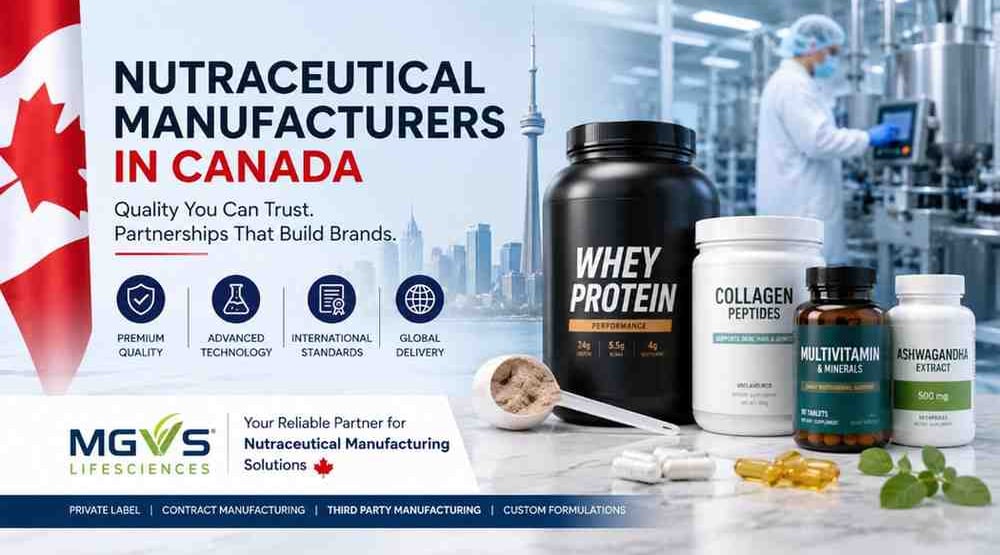
Nutraceutical Manufacturers in Canada
Looking for trusted nutraceutical manufacturers in Canada? Learn how to choose the right partner and why brands choose MGVS Lifesciences.
Why Are So Many Canadian Supplement Brands Looking for Nutraceutical Manufacturers in Canada and Abroad?
The Canadian nutraceutical industry has grown rapidly over the last few years. Consumers are becoming more health conscious, sports nutrition continues to expand, and demand for vitamins, herbal supplements, protein powders, collagen, probiotics, and functional foods keeps increasing. As a result, many entrepreneurs are entering the supplement business with innovative ideas but without their own manufacturing facilities.
This is why searches for nutraceutical manufacturers in Canada have increased significantly. Brand owners want experienced manufacturing partners who can convert their ideas into market-ready products while maintaining consistent quality, regulatory compliance, and reliable delivery timelines.
Interestingly, many Canadian companies are no longer limiting their search to domestic manufacturers. They are also exploring established manufacturing partners in countries like India, where advanced production capabilities, competitive manufacturing costs, and global quality standards make international partnerships commercially attractive.
Launching a supplement brand involves much more than selecting a formula. Brands need assistance with ingredient sourcing, product development, flavour selection, packaging, stability testing, regulatory documentation, and production planning. Working with an experienced manufacturer simplifies this entire process.
One situation we often notice is that startups spend months creating a brand identity and marketing strategy but spend only a few days evaluating their manufacturing partner. That imbalance creates avoidable problems later. Delays in label approvals, inconsistent flavours, packaging defects, or unexpected production timelines can postpone a product launch by several weeks.
I still remember seeing cartons stacked in a warehouse during peak summer. It reminded everyone how important proper storage conditions are before products even reach distributors.
Many Canadian businesses also choose overseas manufacturing because it provides access to a wider range of dosage forms and product categories under one roof. Instead of managing multiple suppliers, they can manufacture protein powders, capsules, tablets, gummies, sachets, and liquid supplements through a single experienced manufacturer.
For businesses planning international expansion, working with a manufacturer experienced in export documentation, shipping compliance, and international packaging requirements offers another significant advantage.
Companies like MGVS Lifesciences support global supplement brands by offering private label manufacturing, contract manufacturing, custom nutraceutical formulations, and third party manufacturing solutions while following internationally accepted quality practices. This enables Canadian businesses to focus on building their brands while manufacturing remains in experienced hands.
What Products Can You Manufacture Through a Nutraceutical Manufacturing Partner?
One of the biggest advantages of working with professional nutraceutical manufacturers in Canada or experienced international manufacturers is product flexibility. Modern manufacturing facilities are equipped to produce a wide variety of nutritional supplements for different customer segments.
Sports nutrition remains one of the fastest growing categories. Products such as whey protein concentrates, whey protein isolates, mass gainers, pre workout supplements, BCAA formulations, EAA blends, creatine powders, hydration formulas, recovery supplements, and meal replacement shakes continue to see strong demand among athletes and fitness enthusiasts.
Healthcare professionals are also launching their own branded supplements. Doctors, nutritionists, and wellness clinics frequently introduce vitamin and mineral formulations, calcium supplements, probiotics, omega fatty acids, liver support products, joint care supplements, immunity boosters, women's health products, and children's nutrition products under private labels.
Many Ayurvedic wellness brands combine traditional herbal ingredients with modern nutraceutical science. Ashwagandha, Shilajit, Curcumin, Moringa, Giloy, Spirulina, and plant based extracts are commonly formulated into capsules, powders, tablets, or liquid supplements.
Manufacturing capabilities usually include:
Product Category
Common Formats
Protein Supplements
Powder, Sachets
Sports Nutrition
Powder, Capsules
Vitamins and Minerals
Tablets, Capsules
Herbal Supplements
Capsules, Tablets, Powders
Immunity Supplements
Gummies, Syrups, Capsules
Digestive Health
Probiotics, Powders, Capsules
Weight Management
Powders, Tablets, Capsules
Children's Nutrition
Gummies, Syrups
Women's Wellness
Tablets, Capsules
Liquid Nutraceuticals
Bottles, Ready to Drink Products
Custom formulation has become equally important. Instead of choosing standard formulations, brands increasingly request unique ingredient combinations that differentiate them from competitors. This may involve developing exclusive flavours, adjusting sweetness levels, improving mixability, or incorporating clinically studied ingredients.
Flavour development often takes longer than many first time entrepreneurs expect. A chocolate protein powder that tastes excellent during laboratory trials may behave differently when produced in commercial quantities. Multiple production trials are sometimes required before the final product meets customer expectations.
Packaging also plays an important role in product success. Depending on market positioning, manufacturers can provide jars, pouches, bottles, blister packs, stick packs, sachets, or single serving packaging options. Label design, regulatory declarations, batch coding, and tamper evident packaging are equally important considerations before commercial production begins.
Businesses working with MGVS Lifesciences also benefit from integrated manufacturing services across protein powder manufacturing, capsule manufacturing, tablet manufacturing, liquid supplement manufacturing, sports nutrition manufacturing, custom nutraceutical formulation, contract manufacturing, private label manufacturing, and third party manufacturing. Having these capabilities under one manufacturing partner often simplifies inventory planning and future product expansion.
How to Evaluate Nutraceutical Manufacturers in Canada Before Signing a Manufacturing Agreement
Selecting the right manufacturing partner influences product quality, customer satisfaction, and long term brand reputation. While many businesses initially compare only pricing, experienced brand owners evaluate several other factors before making a decision.
The first aspect to examine is manufacturing certifications. Reliable manufacturers should follow Good Manufacturing Practices and maintain appropriate quality management systems. Regulatory compliance demonstrates that products are manufactured under controlled conditions with documented quality procedures.
Next comes ingredient sourcing. Ask where raw materials originate, whether suppliers are qualified, and how incoming ingredients are tested. Premium ingredients may increase manufacturing costs slightly, but they often reduce quality complaints later.
Quality testing should extend beyond finished products. Reputed manufacturers conduct testing at multiple stages including raw material verification, in process quality checks, microbiological analysis, heavy metal testing where applicable, and finished product evaluation before dispatch.
Minimum Order Quantity, commonly called MOQ, is another important factor. Many startups focus heavily on finding the lowest MOQ because they want to reduce initial investment. That approach certainly makes sense for businesses entering the market with limited budgets.
However, I might be wrong here, but this does not apply to every manufacturer.
As businesses grow, manufacturing consistency, product quality, technical support, and supply reliability usually become far more valuable than simply choosing the smallest MOQ available. A manufacturer capable of supporting long term expansion often becomes a better business partner than one offering only low minimum quantities.
Another area that deserves careful attention is formulation support. Does the manufacturer simply produce what you provide, or can they help improve ingredient selection, nutritional profile, flavour, shelf stability, and product positioning? Experienced formulation teams frequently identify improvements that first time supplement brands may overlook.
Lead time should also be discussed in detail. Manufacturing schedules depend on raw material availability, packaging procurement, production planning, laboratory testing, and final dispatch. Unrealistic launch expectations often create unnecessary pressure for both the brand owner and the manufacturer.
One common mistake involves label compliance. Many entrepreneurs invest heavily in attractive packaging designs before verifying whether mandatory declarations satisfy regulatory requirements. Even small compliance errors can delay product launches while labels are revised and reprinted.
Questions worth asking before finalising a manufacturing partner include:
Which certifications does the manufacturing facility maintain?
Can custom formulations be developed?
What quality tests are conducted before dispatch?
What are the expected production lead times?
How is batch consistency maintained?
Does the manufacturer support export documentation?
Are packaging and label compliance services available?
Can future product categories be manufactured within the same facility?
Companies such as MGVS Lifesciences work closely with domestic and international brands throughout this evaluation process by offering technical guidance, transparent communication, scalable manufacturing solutions, and comprehensive support from formulation to commercial production. For Canadian businesses looking beyond local manufacturing, partnering with an experienced Indian nutraceutical manufacturer can provide both operational flexibility and long term manufacturing confidence.
Canada vs India: Which Manufacturing Destination Offers Better Value for Nutraceutical Brands?
Many businesses initially assume that choosing nutraceutical manufacturers in Canada is always the safest option because production takes place within the country. While that works well for certain brands, it is no longer the only path to building a successful supplement business.
Today, many Canadian companies manufacture their products in India while continuing to sell them under Canadian brands. The reason is not simply lower production costs. Modern Indian nutraceutical manufacturers have invested heavily in automated manufacturing lines, quality control laboratories, research and development, and international certifications.
The comparison is much broader than pricing.
Canadian manufacturers may offer shorter domestic logistics, easier communication within the same time zone, and familiarity with local regulations. However, production costs, labour expenses, raw material sourcing, and packaging often increase the overall manufacturing budget.
India offers several advantages for growing supplement brands. The country has access to a large ingredient supply network, experienced formulation scientists, flexible manufacturing capabilities, and significant expertise in exporting nutraceutical products to international markets.
A practical comparison looks like this:
Factor
Canada
India
Manufacturing Cost
Higher
More competitive
Product Range
Wide
Very wide
Custom Formulations
Available
Extensive options
Export Experience
Moderate
Strong global experience
Production Capacity
Good
Highly scalable
Lead Time
Faster for domestic orders
Competitive with planned logistics
Private Label Services
Available
Highly developed
That said, selecting a country should never depend only on manufacturing costs.
Earlier we discussed how MOQ is important, but sometimes quality becomes the deciding factor. Paying slightly more for consistent production, reliable testing, and responsive technical support often saves much more money than choosing the cheapest quotation.
Canadian businesses planning to launch multiple product categories often find greater flexibility with experienced Indian manufacturers. Instead of managing separate suppliers for protein powders, capsules, tablets, gummies, and liquids, they can manufacture everything through one facility.
MGVS Lifesciences supports international brands by offering scalable manufacturing, custom formulation development, export documentation assistance, and private label solutions that meet global quality expectations. This allows Canadian businesses to maintain brand control while benefiting from India's advanced manufacturing ecosystem.
Understanding Private Label, Contract Manufacturing, and Third Party Manufacturing for Nutraceutical Products
Many entrepreneurs entering the supplement industry use these terms interchangeably, but they actually describe different business models. Understanding these differences helps you choose the right manufacturing approach.
Private Label Manufacturing
Private label manufacturing allows brands to launch products using existing formulations developed by the manufacturer. The brand focuses on packaging, marketing, and sales while the manufacturing partner handles production.
This model works well for businesses that want to enter the market quickly without investing months in research and formulation development.
Contract Manufacturing
Contract manufacturing is a more collaborative process. The brand usually develops its own formulation or works closely with the manufacturer to create a unique product. Manufacturing takes place according to agreed specifications while maintaining confidentiality.
Doctor owned supplement brands, sports nutrition companies, and premium wellness businesses often prefer contract manufacturing because it allows greater product differentiation.
Third party manufacturing involves outsourcing production to an experienced manufacturing company while the brand retains ownership of the product and focuses on distribution, marketing, and customer acquisition.
This model has become increasingly popular because it reduces capital investment. Instead of building a manufacturing facility, brands can utilise established production infrastructure with experienced technical teams.
The differences can be understood easily.
Manufacturing Model
Best For
Major Advantage
Private Label
New brands
Faster product launch
Contract Manufacturing
Premium brands
Custom formulations
Third Party Manufacturing
Growing businesses
Lower investment with scalable production
Each model has its place depending on business goals.
A gym owner launching a whey protein brand may begin with private label manufacturing. As sales increase, the business might later move to contract manufacturing for exclusive flavours and customised formulations.
Similarly, healthcare professionals introducing branded nutritional supplements often start with third party manufacturing before expanding into broader product portfolios.
MGVS Lifesciences supports all three manufacturing models, enabling businesses to choose a solution that matches their investment capacity, branding strategy, and long term growth plans.
Quality Standards, Certifications, and Regulatory Compliance Every Manufacturer Should Meet
When comparing nutraceutical manufacturers in Canada, quality should always receive more attention than marketing brochures or attractive pricing.
Every batch of supplements represents your brand. If quality fails once, rebuilding customer trust becomes extremely difficult.
Reliable manufacturers maintain strict quality systems throughout production. Quality begins long before manufacturing starts. Raw materials should be sourced from qualified suppliers and verified before entering production.
Testing generally includes ingredient identification, purity verification, microbiological analysis, moisture evaluation where applicable, and finished product inspection before dispatch.
Manufacturers should also follow recognised quality systems such as:
Good Manufacturing Practices (GMP)
ISO certified quality management systems
FSSAI compliance for products manufactured in India
Standard operating procedures for production and hygiene
Batch traceability and documentation
Stability testing where required
Controlled warehouse storage conditions
Documentation matters just as much as manufacturing.
Exporting nutraceutical products often requires certificates, batch records, Certificates of Analysis, ingredient documentation, shipping paperwork, and product specifications. Businesses planning international sales should confirm that their manufacturing partner can provide complete documentation whenever required.
Another overlooked factor is label compliance.
Incorrect ingredient declarations, missing allergen information, inaccurate nutritional values, or incomplete regulatory statements may delay product launches and create unnecessary expenses.
Sometimes clients negotiate a few cents per kilogram while ignoring documentation quality, and that decision becomes expensive later.
Experienced manufacturers work closely with brands to review labels before printing, reducing the possibility of compliance related delays.
MGVS Lifesciences follows systematic manufacturing practices with strong emphasis on quality assurance, documentation, regulatory compliance, and transparent production processes, helping domestic and international brands build long term confidence in their products.
Custom Formulations, Packaging Options, and Product Development That Help Your Brand Stand Out
The supplement industry has become highly competitive. Selling another vanilla protein powder with standard packaging is no longer enough to build a memorable brand.
Today's successful brands focus on differentiation.
Custom formulations allow businesses to combine ingredients based on specific market demands. A sports nutrition startup may request higher protein content with digestive enzymes. A wellness company may develop collagen blended with vitamins and botanical extracts. A doctor may require specialised formulations for clinical nutrition.
This flexibility creates stronger product positioning and better customer recognition.
Flavour development is another important stage.
Chocolate, café mocha, mango, cookies and cream, kesar pista, and tropical fruit flavours may sound simple, but developing a stable formulation with good taste and mixability often requires several production trials.
I have seen brands reject excellent nutritional formulations simply because the aftertaste did not meet customer expectations.
Packaging also influences buying decisions.
Manufacturers generally offer:
HDPE jars
PET bottles
Stand up pouches
Sachets
Stick packs
Blister packs
Glass bottles
Bulk packaging for institutional buyers
Beyond aesthetics, packaging protects product stability, improves shelf life, and enhances customer experience.
Product development also includes selecting serving sizes, scoop design, label layout, nutritional information panels, batch coding, expiry management, and transport friendly packaging.
Some discussions about packaging become surprisingly long.
Businesses working with MGVS Lifesciences benefit from integrated formulation support, flavour development, packaging consultation, label guidance, and manufacturing expertise that helps transform product ideas into commercially successful supplements.
Common Challenges Brands Face While Working With Nutraceutical Manufacturers and How to Avoid Them
Even after selecting experienced nutraceutical manufacturers in Canada or international partners, challenges can still arise if expectations are not discussed clearly.
One of the most common issues involves communication.
Brands sometimes assume production begins immediately after placing an order, while manufacturers may still be waiting for approved artwork, packaging materials, or final formulation confirmation.
Another frequent challenge involves raw material availability.
Certain botanical extracts, imported ingredients, or specialty proteins may have fluctuating supply timelines. Planning production schedules well in advance helps reduce these disruptions.
Packaging delays also affect launch dates.
A product may be fully manufactured, but if printed jars or labels arrive late, dispatch cannot proceed. Coordinating packaging procurement alongside manufacturing is therefore essential.
New businesses often underestimate regulatory reviews as well.
Minor changes in ingredient lists or nutritional panels can require updated artwork, revised approvals, and additional verification before commercial production begins.
Shipping creates another layer of complexity, particularly for export orders. Proper documentation, customs procedures, palletisation, warehouse handling, and freight scheduling all influence final delivery timelines.
Brands that maintain regular communication with their manufacturing partner generally experience fewer surprises.
Before confirming any production schedule, discuss:
Product specifications
Ingredient availability
Packaging timelines
Laboratory testing requirements
Documentation needs
Shipping schedules
Future scaling plans
Choosing a manufacturing partner should never be based solely on today's order.
It should support your business two years from now when product demand increases, new formulations are introduced, and international expansion becomes part of your growth strategy.
That is where experienced manufacturers like MGVS Lifesciences provide long term value by combining technical expertise, flexible manufacturing capabilities, consistent quality systems, and dedicated support throughout the product lifecycle.
Why Global Brands Choose MGVS Lifesciences for Reliable Nutraceutical Manufacturing Solutions
Finding reliable nutraceutical manufacturers in Canada is only one part of building a successful supplement business. The larger question is whether your manufacturing partner can continue supporting your brand as it grows from a single product to an international portfolio.
That is one reason many businesses choose to work with experienced global manufacturers like MGVS Lifesciences.
Rather than acting only as a production facility, MGVS Lifesciences works alongside brands during formulation, manufacturing, packaging, quality assurance, and product development. This collaborative approach helps businesses avoid many of the challenges that typically appear during product launches.
Whether a company wants to introduce a whey protein range, sports nutrition supplements, herbal capsules, multivitamins, collagen powders, immunity products, or customised wellness formulations, the manufacturing process remains organised under one experienced team.
Some of the key manufacturing capabilities include:
Private Label Supplement Manufacturing
Third Party Nutraceutical Manufacturing
Contract Manufacturing
Custom Nutraceutical Formulations
Protein Powder Manufacturing
Whey Protein Manufacturing
Mass Gainer Manufacturing
Pre Workout Manufacturing
Creatine Manufacturing
Sports Nutrition Manufacturing
Capsule Manufacturing
Tablet Manufacturing
Liquid Supplement Manufacturing
One advantage that international clients appreciate is the ability to expand without changing manufacturing partners. A startup may initially launch two protein powders, then later introduce capsules, tablets, or functional wellness products through the same manufacturing facility.
Consistency becomes much easier when one manufacturer understands your formulations, packaging standards, documentation requirements, and quality expectations.
MGVS Lifesciences also places significant emphasis on ingredient sourcing, production planning, laboratory testing, regulatory documentation, and export support. For Canadian businesses importing supplements, having an experienced export partner reduces unnecessary complications related to shipping documentation and international logistics.
I have seen businesses spend months searching for the cheapest quotation, only to switch manufacturers within a year because communication became difficult or product consistency suffered. Building a long term relationship with a dependable manufacturing partner usually creates far more value than changing suppliers repeatedly.
If your objective is simply to manufacture one product, many companies can help.
If your objective is to build a supplement brand that continues growing over the next five or ten years, the choice of manufacturing partner becomes much more important.
Before making your final decision, ask yourself one question.
Can this manufacturer still support my business when my monthly production becomes ten times larger?
That question often changes how brands evaluate their manufacturing partner.
Frequently Asked Questions About Nutraceutical Manufacturers in Canada
1. Why are many Canadian brands also choosing nutraceutical manufacturers outside Canada?
Many Canadian brands work with international manufacturers because they offer competitive manufacturing costs, wider product categories, custom formulation expertise, scalable production capacity, and strong export support while maintaining recognised quality standards.
2. Can Indian manufacturers supply nutraceutical products to Canadian businesses?
Yes. Experienced Indian manufacturers regularly export nutraceutical products to international markets. They provide manufacturing, documentation, quality testing, packaging, and export assistance according to customer requirements.
3. What certifications should I look for before choosing a nutraceutical manufacturer?
Look for manufacturers that follow Good Manufacturing Practices (GMP), maintain ISO certified quality systems where applicable, comply with relevant food safety regulations, and have robust quality control and documentation procedures.
4. What products can be manufactured through a nutraceutical manufacturing company?
Most manufacturers produce protein powders, whey protein, mass gainers, pre workout supplements, creatine, vitamins, minerals, herbal supplements, capsules, tablets, gummies, liquid supplements, collagen products, probiotics, immunity formulations, and customised nutritional products.
5. What is the difference between private label and contract manufacturing?
Private label manufacturing uses existing formulations that can be sold under your brand name, making product launches faster. Contract manufacturing involves developing customised formulations according to your specifications, offering greater product differentiation.
6. Is a lower MOQ always the best option?
Not necessarily. Lower MOQ is helpful for startups with limited investment, but as your business grows, consistent quality, dependable supply, technical expertise, and manufacturing reliability usually become more important than simply choosing the lowest minimum order quantity.
7. How long does nutraceutical manufacturing usually take?
Production timelines depend on formulation complexity, raw material availability, packaging procurement, laboratory testing, artwork approval, and order size. Planning well in advance helps avoid unnecessary launch delays.
8. Does MGVS Lifesciences provide custom formulation services?
Yes. MGVS Lifesciences supports businesses with custom nutraceutical formulations, flavour development, private label manufacturing, contract manufacturing, third party manufacturing, packaging consultation, and production across a wide range of nutraceutical categories.
9. Can MGVS Lifesciences manufacture products for export?
Yes. MGVS Lifesciences works with domestic as well as international brands and supports export focused manufacturing by providing quality documentation, production expertise, and assistance throughout the manufacturing process.
10. How should I choose between nutraceutical manufacturers in Canada and overseas manufacturers?
Compare manufacturers based on quality systems, certifications, production capabilities, formulation expertise, communication, documentation, scalability, and long term business support rather than focusing only on manufacturing cost. A reliable manufacturing partner should be able to support your brand as it grows into new markets and product categories.