Third Party Manufacturing Nutraceuticals in India
how third party manufacturing nutraceuticals work, key certifications, costs, MOQ, and how to choose the right manufacturing partner in India.
Why More Supplement Brands Are Choosing Third Party Manufacturing Nutraceuticals in India
Launching a supplement brand today is far more competitive than it was a few years ago. Consumers expect premium ingredients, attractive packaging, quick delivery, and complete regulatory compliance. At the same time, setting up a manufacturing facility requires a significant investment in machinery, trained staff, quality testing laboratories, certifications, and approvals. For many entrepreneurs, this simply isn't practical.
That is why third party manufacturing nutraceuticals has become one of the fastest-growing business models in India's health and wellness industry. Instead of investing crores in production infrastructure, brands can partner with an experienced manufacturer and focus on building their customer base, creating effective marketing campaigns, and expanding distribution.
This model works particularly well for startups, gym owners launching their own supplement line, doctors introducing branded wellness products, pharmacies, exporters, and established FMCG companies entering the nutraceutical market.
India has also become a preferred manufacturing destination because of its strong supply chain for herbal extracts, vitamins, minerals, proteins, amino acids, probiotics, and functional ingredients. Combined with internationally accepted manufacturing standards such as GMP, ISO, and FSSAI compliance, Indian manufacturers are now supplying products to both domestic and international markets.
One thing I have noticed after working with several supplement launches is that many businesses spend months designing logos, building websites, and planning influencer campaigns. Then they select a manufacturing partner after a single meeting. That decision often creates the biggest challenges later, from delayed production to inconsistent product quality.
Another reason businesses prefer third party manufacturing nutraceuticals is flexibility. A brand can begin with a limited product range such as whey protein, multivitamins, or immunity supplements and gradually expand into capsules, tablets, gummies, powders, effervescent tablets, or liquid supplements without investing in additional production facilities.
MGVS Lifesciences works with businesses at different stages of growth by supporting private label manufacturing, custom formulations, contract manufacturing, and complete third party manufacturing nutraceuticals solutions. This allows brands to scale while maintaining consistent product quality and regulatory compliance.
Interestingly, many successful supplement brands you see on online marketplaces or pharmacy shelves do not own manufacturing plants. Their strength lies in product development, branding, and customer engagement, while manufacturing is handled by experienced partners who specialize in third party manufacturing nutraceuticals.
What Does Third Party Manufacturing Nutraceuticals Actually Mean for Your Business?
The term third party manufacturing nutraceuticals simply means that your company owns the brand, while an experienced manufacturer produces the products according to your specifications.
You remain responsible for marketing, sales, and brand development. The manufacturing partner takes care of sourcing raw materials, production, quality testing, packaging, documentation, and dispatch.
Think of it as building a supplement company without building a factory.
For example, suppose you want to launch a whey protein brand for fitness enthusiasts. Instead of purchasing blending machines, filling equipment, testing instruments, and packaging lines, you can collaborate with a manufacturer that already has this infrastructure in place.
The typical workflow usually looks like this.
Stage
Responsibility
Product Selection
Brand Owner
Formula Finalization
Brand Owner and Manufacturer
Raw Material Procurement
Manufacturer
Manufacturing
Manufacturer
Quality Testing
Manufacturer
Packaging
Manufacturer
Label Compliance
Manufacturer with Brand Approval
Dispatch
Manufacturer
Marketing and Sales
Brand Owner
One major advantage of third party manufacturing nutraceuticals is faster market entry. A business can often launch products within weeks instead of spending a year setting up production facilities.
Cost efficiency is another reason companies choose this model. Rather than investing heavily in equipment and infrastructure, businesses can allocate more resources to digital marketing, distribution, product education, and customer acquisition.
I might be wrong here, but this does not apply to every manufacturer. Some manufacturers are excellent at producing sports nutrition but may have limited experience with herbal formulations or pediatric nutraceuticals. Evaluating technical expertise is just as important as comparing pricing.
Minimum Order Quantity, commonly called MOQ, is another area where many new brands get confused. They often believe choosing the manufacturer with the lowest MOQ is always the smartest decision. Lower MOQ certainly reduces initial investment, but it should never become the only deciding factor.
I still remember seeing cartons stacked in a warehouse during peak summer.
That image always reminds me how storage conditions can influence product quality long after manufacturing is complete.
Which Nutraceutical Products Can Be Manufactured Through a Third Party Manufacturing Partner?
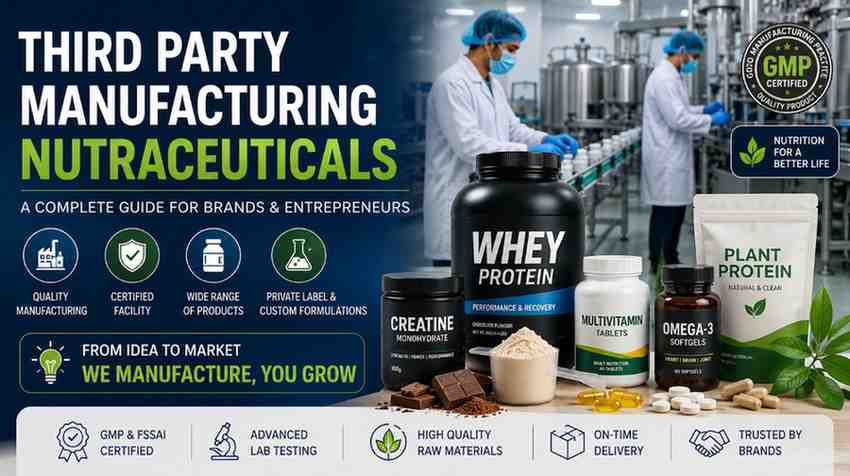
One of the biggest strengths of third party manufacturing nutraceuticals is product diversity. Instead of being limited to one dosage form or category, brands can develop an entire portfolio under a single manufacturing partnership.
Depending on the manufacturer's capabilities, products may include:
Product Category
Common Applications
Whey Protein
Muscle recovery and sports nutrition
Mass Gainers
Weight gain and bodybuilding
Plant Protein
Vegan nutrition
Pre Workout Supplements
Performance and endurance
Creatine Products
Strength and athletic performance
BCAA and EAA Supplements
Recovery support
Multivitamin Tablets
Daily wellness
Calcium and Vitamin D
Bone health
Herbal Capsules
Ayurvedic wellness
Gummies
Kids and adult nutrition
Effervescent Tablets
Instant nutrition
Liquid Supplements
General health and immunity
Softgel Capsules
Omega oils and fat soluble vitamins
Protein Cookies and Nutrition Bars
Functional snacking
A reliable manufacturing partner should also support services beyond production. These often include custom nutraceutical formulation, flavour development, stability studies, packaging selection, artwork guidance, label compliance, and export documentation.
For example, a gym owner may want a chocolate whey protein with digestive enzymes, while a doctor may require sugar-free multivitamin tablets for clinical practice. Although both fall under third party manufacturing nutraceuticals, the formulation process, ingredient selection, packaging, and testing requirements are completely different.
Another growing trend is private label manufacturing. Here, businesses choose proven formulations already developed by the manufacturer and simply launch them under their own brand name. This significantly reduces development time while allowing faster market entry.
On the other hand, brands looking to create a unique identity often choose custom formulations. They may request specific protein concentrations, botanical extracts, flavour combinations, sweeteners, or functional ingredients that differentiate their products from competitors.
Earlier, we discussed how MOQ plays an important role. That remains true for budgeting and inventory planning. However, once a brand starts building long term customer trust, consistent product quality becomes far more valuable than saving a small amount through a lower MOQ. Many successful brands eventually realise this after a few production cycles.
Whether your business focuses on sports nutrition, wellness supplements, Ayurvedic nutraceuticals, pediatric nutrition, or preventive healthcare, choosing an experienced partner like MGVS Lifesciences for third party manufacturing nutraceuticals can simplify product development while allowing your team to concentrate on growing the brand rather than managing production complexities.
How the Third Party Manufacturing Nutraceuticals Process Works from Idea to Market
Many first time entrepreneurs assume manufacturing begins when raw materials enter the factory. In reality, third party manufacturing nutraceuticals starts much earlier, often with a simple business idea.
A gym owner may want to launch a premium whey protein. A doctor may plan to introduce a joint care supplement for patients. An Ayurvedic company may wish to expand into modern nutraceuticals. Every successful product begins with identifying a genuine market requirement.
The next step is selecting the right formulation. Some brands already know the ingredients they want, while others rely on the manufacturer's research and development team to recommend a formulation based on current market trends and regulatory requirements.
Once the formula is finalized, approved suppliers provide the raw materials. A professional manufacturer never selects ingredients based only on price. Each batch should undergo quality checks for identity, purity, microbial limits, and other required parameters before entering production.
Manufacturing itself follows Standard Operating Procedures under GMP conditions. Powders are blended carefully to ensure uniform mixing. Tablets and capsules are produced using validated processes. Liquids require different equipment and quality controls, while gummies and effervescent tablets demand even more specialized production environments.
Quality testing continues throughout manufacturing rather than only at the end. Samples are checked at different stages to ensure consistency, stability, and compliance with approved specifications.
Packaging is another stage where brands often underestimate the importance of planning. Choosing between jars, stand-up pouches, sachets, blister packs, HDPE bottles, or glass containers depends on the product, shelf life, transportation requirements, and target customers.
Label compliance is equally critical. Every product must meet FSSAI regulations regarding ingredient declaration, nutritional information, allergen statements, recommended usage, storage instructions, and mandatory warnings wherever applicable.
Finally, products are packed, dispatched, and delivered according to the agreed production schedule.
A typical third party manufacturing nutraceuticals timeline may look like this:
Stage
Estimated Time
Product Discussion
2 to 5 days
Formula Finalization
5 to 10 days
Label and Packaging Approval
7 to 15 days
Raw Material Procurement
10 to 20 days
Manufacturing and Testing
10 to 15 days
Packaging and Dispatch
5 to 7 days
Lead times vary depending on ingredient availability, packaging materials, seasonal demand, and production schedules. During periods of high demand, especially before major festive sales or sports seasons, production slots may fill quickly.
One thing that surprises many new brands is how much coordination happens behind the scenes before the first container is sealed.
Certifications, Quality Standards, and Compliance Every Manufacturer Should Meet
Choosing a manufacturer only because they offer competitive pricing can become an expensive mistake later. Certifications exist for a reason. They indicate that manufacturing follows documented systems designed to maintain consistent quality and regulatory compliance.
Before selecting a company for third party manufacturing nutraceuticals, businesses should verify essential certifications and approvals.
Certification
Why It Matters
FSSAI License
Legal requirement for food and nutraceutical manufacturing in India
GMP Certification
Ensures standardized manufacturing practices
ISO Certification
Demonstrates quality management systems
HACCP
Focuses on food safety risk management
WHO GMP, where applicable
Preferred for many international buyers
Export Documentation Support
Important for overseas distribution
Apart from certifications, ask practical questions.
How frequently are manufacturing facilities audited?
Are raw materials sourced from approved vendors?
Does the company maintain batch traceability?
Is every production batch tested before dispatch?
Can they provide Certificates of Analysis when required?
These questions often reveal more about a manufacturer than a glossy company brochure.
Testing is another area that deserves attention. Depending on the product category, manufacturers may perform microbial testing, heavy metal analysis, nutritional verification, moisture testing, stability studies, and packaging compatibility assessments.
For sports nutrition products such as whey protein, creatine, or pre workout supplements, maintaining formulation consistency is especially important because customers often purchase the same product repeatedly. Even small differences in taste, texture, or mixability can affect brand reputation.
I have seen businesses spend heavily on premium packaging while overlooking laboratory testing. That usually becomes a far bigger issue than a slightly delayed launch.
What Factors Affect Cost, MOQ, Lead Time, and Product Quality in Third Party Manufacturing Nutraceuticals?
No two manufacturing quotations are exactly the same because several factors influence pricing in third party manufacturing nutraceuticals.
The quality of raw materials is one of the biggest cost drivers. Imported ingredients, patented extracts, premium proteins, branded vitamins, and clinically researched ingredients naturally increase manufacturing costs.
Packaging choices also make a noticeable difference. A premium matte finish jar with induction sealing, shrink sleeves, measuring scoops, and printed cartons costs considerably more than a basic pouch packaging option.
Custom flavour development adds another layer of investment. Creating a smooth chocolate whey protein or a refreshing orange effervescent tablet may require several trials before the final version is approved.
Minimum Order Quantity also affects pricing. Larger production runs generally reduce manufacturing costs because setup expenses are distributed across higher volumes.
That said, MOQ should never become the only deciding factor. Earlier we discussed how lower MOQ can help startups reduce initial investment. That is true. But once your brand begins building loyal customers, consistent quality, reliable supply, and dependable service become much more valuable than saving a small amount on each kilogram.
Lead time depends on multiple variables, including raw material availability, imported ingredients, custom packaging, production scheduling, and seasonal demand.
Shipping logistics also influence timelines. Some businesses forget to account for transportation during summer or monsoon seasons, particularly when products need careful storage conditions.
Sometimes clients negotiate ₹20 per kg while ignoring product quality, and that decision becomes expensive later.
It sounds harsh, but it happens more often than people think.
Common Mistakes Brands Make While Selecting a Third Party Manufacturing Nutraceuticals Company
Choosing the wrong manufacturing partner can delay product launches, increase costs, and damage customer trust before a brand has even established itself.
One common mistake is comparing manufacturers only on price. Lower quotations may seem attractive initially, but businesses should understand exactly what is included. Does the quotation cover testing, packaging, label compliance, artwork support, or only manufacturing?
Another mistake is failing to verify manufacturing capability. A company producing herbal capsules may not necessarily have extensive experience with sports nutrition powders or flavored protein products.
Many startups also ignore flavour trials.
Protein may have excellent nutritional value, but if customers dislike the taste, repeat purchases become difficult.
Documentation is another overlooked area. Before approving third party manufacturing nutraceuticals, businesses should understand ownership of formulations, packaging designs, trademarks, and regulatory documentation.
Some entrepreneurs become so excited about launching quickly that they skip sample evaluation completely.
That rarely ends well.
Warehouse planning also deserves attention. Finished products require appropriate storage conditions to preserve quality throughout their shelf life. Poor warehouse management can affect even well-manufactured products.
I might be repeating myself here, but selecting a manufacturing partner should never feel like purchasing office furniture. The relationship often continues for years, and changing manufacturers later can involve reformulation, packaging revisions, regulatory updates, and customer communication.
How MGVS Lifesciences Supports Private Label, Custom Formulation, and Third Party Manufacturing Nutraceuticals
Every supplement brand has different requirements. Some businesses want to launch products immediately using proven formulations, while others prefer developing completely customized products that reflect their own market positioning.
MGVS Lifesciences supports both approaches through its third party manufacturing nutraceuticals capabilities.
For businesses looking to enter the market quickly, private label manufacturing offers an efficient path. Existing formulations can be manufactured under the client's own brand with customized packaging and label design, reducing product development time.
Brands seeking differentiation can choose custom nutraceutical formulation. This involves selecting specific ingredients, dosage strengths, flavours, sweetening systems, packaging formats, and nutritional profiles based on the intended customer segment.
MGVS Lifesciences also supports manufacturing across multiple product categories, including protein powders, whey protein, mass gainers, pre workout supplements, creatine, capsules, tablets, liquid supplements, herbal nutraceuticals, and other sports nutrition products.
Beyond manufacturing, clients receive assistance with formulation development, packaging selection, regulatory documentation, production planning, quality testing, and dispatch coordination. This integrated approach helps simplify the journey from product concept to commercial launch.
Businesses entering export markets can also benefit from documentation support and manufacturing processes designed to meet international quality expectations where applicable.
Launching a supplement brand is rarely just about producing a product. It involves balancing quality, compliance, pricing, branding, logistics, and customer expectations at the same time.
The right third party manufacturing nutraceuticals partner understands that every successful supplement on the shelf represents hundreds of small decisions made correctly long before the customer opens the jar.
Questions You Should Ask Before Finalizing a Third Party Manufacturing Nutraceuticals Partner
Selecting a company for third party manufacturing nutraceuticals is not just about comparing quotations. The manufacturer you choose will have a direct impact on your product quality, delivery timelines, customer satisfaction, and ultimately your brand reputation. Before signing any agreement, take time to ask detailed questions. A reliable manufacturer will answer them openly rather than avoiding them.
Here are some of the most important questions every supplement brand should ask.
Do you manufacture products in a GMP and FSSAI compliant facility?
This should be your first question. Compliance with Indian regulations is essential, and certifications indicate that the manufacturer follows documented quality systems and manufacturing practices.
Can I customize my formulation?
Some businesses want ready-made formulations, while others need unique products to stand out in a competitive market. Ask whether the manufacturer offers custom nutraceutical formulation, ingredient recommendations, flavour development, and dosage customization.
What is your minimum order quantity?
MOQ directly affects your investment. If you are launching your first supplement brand, understand whether the manufacturer offers flexible production quantities without compromising quality.
Where do your raw materials come from?
Ingredient sourcing plays a major role in product quality. A professional manufacturer should work with approved suppliers and maintain proper documentation for every batch of raw materials.
What quality tests are performed before dispatch?
Ask about microbial testing, heavy metal analysis, nutritional verification, stability testing, and Certificates of Analysis. Reliable manufacturers usually have a structured quality assurance process before products leave the facility.
How long does manufacturing usually take?
Understanding lead time helps you plan product launches, inventory, marketing campaigns, and distributor commitments. Unexpected production delays can affect your business if timelines are not discussed in advance.
Will you help with packaging and label compliance?
Many first-time entrepreneurs underestimate the importance of packaging. Confirm whether the manufacturer provides support for label design, regulatory compliance, packaging material selection, and artwork approval.
Can you manufacture different product categories as my business grows?
Today you may launch whey protein, but next year you might add creatine, multivitamins, herbal capsules, or gummies. Working with a manufacturer that offers multiple dosage forms makes future expansion much easier.
Do you provide private label as well as third party manufacturing?
Some businesses prefer launching quickly through private label manufacturing before investing in completely customized formulations. Having both options gives you greater flexibility.
Can I visit your manufacturing facility?
A factory visit often provides more confidence than brochures or presentations. Observing cleanliness, production practices, warehouse management, and quality systems helps you make a more informed decision.
Choosing a manufacturing partner should never be rushed. Ask questions, review documentation, request samples, and understand the complete manufacturing process before making a commitment. A little extra time during supplier selection can save months of operational challenges later.
Frequently Asked Questions About Third Party Manufacturing Nutraceuticals
What is third party manufacturing nutraceuticals?
Third party manufacturing nutraceuticals is a business model where a specialized manufacturer produces dietary supplements under your brand name. The manufacturer handles production, testing, packaging, and quality control, while you focus on branding, sales, and distribution.
Who should choose third party manufacturing nutraceuticals?
It is suitable for startups, supplement brands, gym owners, healthcare professionals, pharmacies, distributors, exporters, wellness companies, and businesses that want to launch products without investing in a manufacturing facility.
What products can be manufactured through third party manufacturing nutraceuticals?
Manufacturers can produce whey protein, mass gainers, creatine, pre workout supplements, protein powders, multivitamins, herbal supplements, capsules, tablets, gummies, softgels, liquid supplements, effervescent tablets, and many other nutraceutical products.
Is private label manufacturing different from third party manufacturing nutraceuticals?
Yes. Private label manufacturing uses existing formulations that are sold under your brand name, while third party manufacturing nutraceuticals may also include custom formulations developed specifically for your business.
How much investment is required to start?
The investment depends on product type, packaging, formulation complexity, MOQ, and branding expenses. A manufacturer can provide a detailed quotation after understanding your product requirements.
How long does it take to launch a nutraceutical product?
Most products can be launched within a few weeks, although timelines vary depending on formulation development, packaging approvals, raw material availability, and production schedules.
What certifications should I check before selecting a manufacturer?
Look for FSSAI licensing, GMP certification, ISO certification, and other quality standards relevant to your target market. If you plan to export, discuss additional documentation requirements with the manufacturer.
Can I create my own custom supplement formula?
Yes. Many manufacturers, including MGVS Lifesciences, support custom formulation services where businesses can choose ingredients, dosage strengths, flavours, packaging formats, and nutritional profiles according to their brand strategy.
Does a lower MOQ always mean a better manufacturing partner?
Not necessarily. Lower MOQ can reduce your initial investment, but long-term success depends more on product consistency, quality control, reliable supply, technical expertise, and customer support than on MOQ alone.
Why do many brands choose MGVS Lifesciences for third party manufacturing nutraceuticals?
MGVS Lifesciences offers private label manufacturing, custom nutraceutical formulation, contract manufacturing, and third party manufacturing nutraceuticals across a wide range of product categories. The company focuses on quality manufacturing practices, regulatory compliance, formulation support, and helping brands move from product concept to commercial launch with confidence.