Nutraceutical Products Manufacturer in India | MGVS
Looking for a trusted nutraceutical products manufacturer in India? MGVS Lifesciences offers private label, custom formulations.

Why Are More Brands Looking for a Nutraceutical Products Manufacturer in India?
The Indian nutraceutical industry has changed rapidly over the last few years. Consumers are no longer buying supplements only after a doctor's recommendation. Daily wellness, preventive healthcare, sports nutrition, immunity support, gut health, women's health, and healthy ageing have become regular conversations, creating opportunities for both established companies and first time entrepreneurs.
This shift has encouraged many businesses to work with a reliable nutraceutical products manufacturer in India instead of setting up their own manufacturing facility. Building a production unit requires significant investment in machinery, qualified technical staff, quality testing laboratories, regulatory approvals, warehouse infrastructure, and ongoing compliance. For most brands, it is far more practical to focus on marketing, distribution, and customer relationships while an experienced manufacturing partner manages production.
Another reason is the growing demand for private label and custom formulations. Gym owners want to introduce their own whey protein range. Doctors are launching branded nutritional supplements for their patients. Ayurvedic wellness companies are expanding into modern nutraceutical products. Even pharmacies and healthcare distributors are creating exclusive product lines to strengthen their market presence.
Many startups also realise that speed matters. Spending a year establishing a factory can delay market entry, whereas partnering with an experienced nutraceutical products manufacturer in India allows products to move from formulation to commercial production much faster.
I still remember seeing cartons stacked in a warehouse during peak summer. It reminded me that manufacturing is not only about producing supplements. Storage conditions, packaging quality, and logistics also decide whether a product reaches customers in perfect condition.
Businesses often spend months perfecting branding and digital marketing but choose the wrong manufacturing partner in a single meeting. That decision can affect product consistency, customer trust, and long term growth far more than they expect.
What Makes India a Preferred Manufacturing Hub for Nutraceutical Products?
India has become one of the most attractive destinations for nutraceutical manufacturing because it combines technical expertise, manufacturing capacity, regulatory compliance, and competitive production costs. This combination has helped Indian manufacturers supply products not only across the domestic market but also to many international destinations.
One major advantage is access to high quality raw materials. India has established supply chains for vitamins, minerals, herbal extracts, amino acids, probiotics, plant based ingredients, and sports nutrition components. Reputed manufacturers also source specialised ingredients globally whenever a formulation requires them, ensuring consistent product quality.
The country also has a strong manufacturing ecosystem supported by qualified food technologists, pharmacists, microbiologists, nutrition experts, and quality assurance professionals. Modern production facilities operate under GMP and ISO certified systems while following FSSAI regulations for dietary supplements. This gives brands greater confidence in product safety and consistency.
Cost efficiency is another important reason businesses choose a nutraceutical products manufacturer in India. Lower manufacturing costs compared to many international markets allow brands to maintain healthy profit margins without compromising quality. However, selecting the lowest quotation is not always the smartest decision. Sometimes clients negotiate ₹20 per kilogram while overlooking ingredient quality, testing standards, or packaging durability. Those savings often disappear when customer complaints begin.
India is also well positioned for export. Many manufacturers have experience with export documentation, product registrations, shipping procedures, and packaging standards required for international markets. This makes it easier for brands planning to expand beyond India in the future.
I might be wrong here, but this does not apply to every manufacturer. Certifications alone do not guarantee excellent manufacturing practices. Visiting the facility, understanding its quality systems, reviewing testing protocols, and discussing previous manufacturing experience provide a much clearer picture before making a long term partnership.
Which Nutraceutical Products Can You Manufacture Under Your Own Brand?
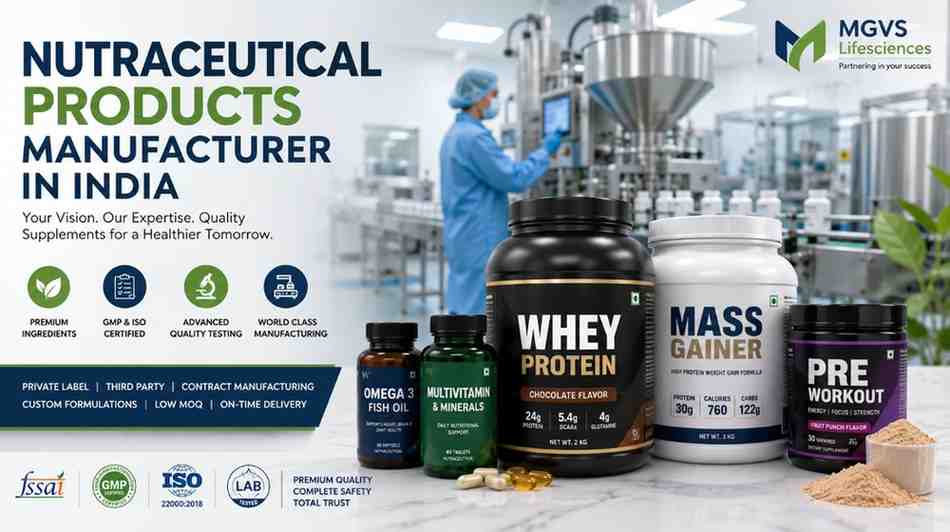
One of the biggest advantages of partnering with an experienced nutraceutical products manufacturer in India is the flexibility to build an entire product portfolio under your own brand. You can begin with one product and gradually expand into multiple categories as your business grows.
Sports nutrition remains one of the fastest growing segments. Brands commonly launch whey protein concentrates, whey protein isolate, mass gainers, pre workout supplements, BCAA formulations, creatine, electrolyte blends, recovery drinks, and protein shakes. Flavour development plays a major role here because repeat purchases often depend as much on taste as nutritional value.
Daily wellness products are equally popular. Multivitamins, immunity boosters, calcium supplements, omega formulations, collagen products, probiotics, digestive health supplements, liver support products, joint care formulations, and heart health supplements continue to see strong demand across different age groups.
Many businesses are also investing in herbal and Ayurvedic nutraceuticals that combine traditional ingredients with modern manufacturing practices. Ashwagandha, Shilajit, Giloy, Turmeric Curcumin, Moringa, Brahmi, and other botanical extracts are widely used in customised formulations for wellness brands.
An experienced manufacturing partner can also produce supplements in multiple dosage formats depending on your target audience.
Product Category
Common Manufacturing Formats
Sports Nutrition
Whey Protein, Mass Gainer, Pre Workout, Creatine, Recovery Drinks
General Wellness
Multivitamins, Immunity Supplements, Calcium, Omega Products
Herbal Nutraceuticals
Ashwagandha, Shilajit, Moringa, Turmeric, Giloy Formulations
Women's Health
Prenatal Nutrition, PCOS Support, Iron and Calcium Supplements
Children's Nutrition
Gummies, Syrups, Chewable Tablets, Powder Mixes
Senior Wellness
Bone Health, Joint Support, Heart Health, Memory Support
Manufacturing formats are equally diverse. Depending on your product strategy, a nutraceutical products manufacturer in India can produce protein powders, capsules, tablets, gummies, softgels, effervescent tablets, oral liquids, sachets, granules, and ready to mix powders.
This flexibility also supports businesses at different stages of growth. A startup may begin with a single whey protein product, while an established healthcare company may simultaneously launch twenty or more SKUs across sports nutrition, immunity, women's health, and preventive wellness categories.
Interestingly, many successful brands do not launch with dozens of products. They start with one carefully developed formulation, understand customer feedback, and then expand gradually. That approach often creates a much stronger foundation for long term growth than introducing too many products at once.
Private Label, Third Party, or Contract Manufacturing. Which Model Fits Your Business?
Many people entering the supplement business assume every manufacturing model works the same way. In reality, choosing the right model depends on your investment, product vision, and long term business plans. An experienced nutraceutical products manufacturer in India will usually explain these options before discussing formulations or pricing because the manufacturing approach affects everything from development timelines to branding.
Private label manufacturing is often the quickest way to launch a supplement brand. The manufacturer already has tested formulations, approved ingredients, and proven production processes. Your role is to select the products, customise the branding, finalise packaging, and introduce them under your own label. This model works well for first time entrepreneurs, gym chains, pharmacies, wellness clinics, and distributors who want to enter the market quickly without spending months on research and development.
Third party manufacturing offers greater flexibility. In this arrangement, you own the brand while the manufacturer produces the supplements according to agreed specifications. You may choose existing formulations or request certain modifications. Many growing supplement companies prefer this option because it balances speed with product differentiation.
Contract manufacturing is usually selected by established brands that require complete control over product specifications. They may already have proprietary formulations, defined ingredient ratios, flavour profiles, packaging standards, and testing requirements. The manufacturer becomes a production partner responsible for converting those specifications into consistent commercial batches.
The table below highlights the practical differences.
Manufacturing Model
Best Suited For
Key Advantage
Private Label
Startups, retailers, gym owners
Faster product launch with proven formulations
Third Party Manufacturing
Growing supplement brands
Greater flexibility with branding and formulations
Contract Manufacturing
Established companies
Full control over product development and production
There is no universally better option. A startup launching its first whey protein may find private label manufacturing ideal, while a healthcare company expanding its nutritional portfolio may benefit more from contract manufacturing.
At MGVS Lifesciences, businesses often discuss future expansion even while developing their first product. That conversation helps create a manufacturing roadmap instead of making isolated decisions for every new product.
What Actually Happens Before Your Nutraceutical Product Goes Into Production?
Many entrepreneurs imagine manufacturing begins the day they approve a quotation. The reality is quite different. Commercial production starts only after several important stages have been completed.
Everything begins with understanding your product idea. Some clients already know exactly what they want. Others arrive with a simple goal such as launching a premium protein powder or immunity supplement but need guidance on ingredients, dosage forms, flavours, packaging, and positioning.
Once the product concept is finalised, formulation experts evaluate ingredient compatibility, nutritional targets, stability, and regulatory requirements. If custom formulation is involved, several trials may be conducted before the final version is approved.
Flavour development can take longer than many people expect. Chocolate whey protein, for example, may go through multiple tasting rounds before achieving the desired texture, sweetness, and aftertaste. Sometimes a flavour that performs well in laboratory samples behaves differently during large scale production.
Raw material procurement follows next. Reliable manufacturers source ingredients only from approved suppliers and verify incoming materials through quality testing before they enter production.
Packaging selection also begins early. Businesses choose between jars, pouches, bottles, blister packs, sachets, and other formats based on their product category, customer preferences, transportation requirements, and pricing strategy.
Label compliance is another critical stage. Product labels must follow FSSAI requirements regarding nutritional information, ingredient declarations, allergen statements, storage instructions, batch details, manufacturing information, and mandatory legal declarations.
I have seen launches delayed simply because label artwork required minor regulatory corrections. Compared with manufacturing, those changes look small, but they can postpone dispatch if ignored.
Only after formulations, packaging materials, labels, quality approvals, and production schedules are aligned does commercial manufacturing begin.
That is usually the point everyone notices.
How Quality Standards, Certifications, and Regulatory Compliance Protect Your Brand
Customers buying supplements may never visit the manufacturing facility, but the quality systems behind every product influence whether they trust your brand enough to purchase again.
A dependable nutraceutical products manufacturer in India follows documented manufacturing practices instead of relying on assumptions. Every stage, from receiving raw materials to dispatching finished products, is monitored through defined quality procedures.
FSSAI compliance forms the foundation of nutraceutical manufacturing in India. Products must meet applicable food safety regulations, ingredient standards, labelling requirements, and manufacturing guidelines. Beyond regulatory compliance, many manufacturers also operate facilities certified under GMP and ISO quality management systems, demonstrating a structured approach to production and quality assurance.
Testing is equally important. Raw materials are evaluated before production begins. During manufacturing, in process quality checks help maintain consistency. Finished products are tested to verify parameters such as appearance, weight variation, moisture levels, microbiological safety, and nutritional specifications wherever applicable.
Protein supplements receive additional attention because customers expect every scoop to deliver consistent nutrition. Variations in raw material quality, mixing procedures, or storage conditions can affect the final product if proper controls are not maintained.
Warehouse management is another area that deserves more attention than it usually receives. Finished products must be stored under suitable environmental conditions until dispatch. Heat, humidity, and poor stock rotation can reduce product quality long before the expiry date.
Many experienced manufacturers also maintain complete batch records and traceability systems. If any issue is reported later, the production history, ingredient sources, and testing reports can be reviewed quickly.
These quality systems may seem routine inside a manufacturing facility, but for the brand selling the product, they help build customer confidence and reduce business risks over time.
Understanding MOQ, Manufacturing Costs, Packaging Choices, and Production Timelines
Almost every new brand asks the same question first.
"What is your MOQ?"
Minimum Order Quantity certainly matters because it influences investment, inventory planning, production efficiency, and pricing. Lower MOQs make it easier for startups to test the market without committing significant capital, while larger production quantities generally reduce the manufacturing cost per unit.
Several factors determine the final manufacturing cost.
Cost Factor
How It Influences Pricing
Raw Material Quality
Premium ingredients increase overall product cost
Custom Formulation
Unique formulations require additional development work
Packaging
Premium jars, pouches, bottles, scoops, and labels affect pricing
Product Format
Powders, capsules, tablets, gummies, and liquids have different production costs
Order Quantity
Higher production volumes usually reduce per unit cost
Testing Requirements
Additional quality testing may increase manufacturing expenses
Packaging decisions also deserve careful consideration. Attractive packaging certainly helps products stand out, but durability matters just as much. A premium label cannot compensate for a container that breaks during transportation.
Lead time varies depending on formulation complexity, raw material availability, packaging procurement, production schedules, and regulatory approvals. Products using imported ingredients or customised packaging may require additional planning.
Earlier, I mentioned that MOQ is important, and it certainly is during business planning. Yet after working with many supplement brands, I have also seen situations where quality became far more important than securing the lowest MOQ. A slightly larger initial investment often results in a product that customers trust, recommend, and purchase repeatedly. That long term value usually outweighs short term savings.
Sometimes businesses spend weeks negotiating a small reduction in manufacturing cost while overlooking formulation quality, flavour consistency, or packaging durability. Those decisions rarely save money in the long run.
Custom Formulations, Flavour Development, and Product Innovation for Growing Supplement Brands
The supplement market has become increasingly competitive. Launching another standard protein powder or multivitamin is rarely enough to create a memorable brand. Businesses are looking for products that offer something different, whether through ingredients, dosage formats, flavour profiles, or specialised health benefits.
This is where product development becomes one of the most valuable services offered by an experienced nutraceutical products manufacturer in India.
Custom formulation begins with understanding the target audience. A sports nutrition brand may need a high protein recovery formula for athletes, while a doctor's clinic may require condition specific nutritional support. Women's wellness brands, children's nutrition companies, Ayurvedic supplement businesses, and senior health brands all have different formulation priorities.
Manufacturers evaluate ingredient compatibility, dosage levels, nutritional objectives, flavour masking requirements, and product stability before recommending the most suitable composition.
Flavour development deserves special attention, particularly in sports nutrition. Consumers today expect supplements to taste good as well as deliver nutritional value. Chocolate, café mocha, mango, kulfi, vanilla, cookies and cream, kesar pista, and fruit based flavours continue to gain popularity, but achieving consistent taste across large production batches requires careful development.
Innovation is also extending beyond ingredients. Gummies, effervescent tablets, ready to drink supplements, stick packs, and convenient single serving sachets are attracting customers who prefer alternatives to traditional tablets and capsules.
At MGVS Lifesciences, custom product development is not limited to creating new formulations. Packaging options, serving sizes, label design support, and manufacturing scalability are also considered so brands can continue expanding without changing production partners every time they introduce a new product.
Many successful supplement brands started with a single carefully developed product instead of launching an entire catalogue. The difference was not the number of products. It was the amount of attention given to creating one product that customers genuinely wanted to buy again.
Why Businesses Across India Choose MGVS Lifesciences as Their Nutraceutical Products Manufacturer in India
Selecting a nutraceutical products manufacturer in India is a long term business decision. Once your products are in the market, changing manufacturers can affect formulation consistency, packaging, customer trust, and supply continuity. That is why many brands spend considerable time evaluating their manufacturing partner before placing the first purchase order.
MGVS Lifesciences works with entrepreneurs, established supplement brands, healthcare professionals, distributors, gym chains, exporters, and wellness companies that want a manufacturing partner capable of supporting both current and future business goals.
One of the strengths of MGVS Lifesciences is its ability to support businesses at different stages. Some clients approach the company with a complete product concept, while others only have an idea and need guidance on formulation, dosage form, packaging, compliance, and manufacturing.
The company offers manufacturing across multiple nutraceutical categories, including sports nutrition, daily wellness supplements, herbal nutraceuticals, protein powders, capsules, tablets, gummies, syrups, liquid supplements, and customised formulations.
Businesses also benefit from integrated manufacturing services rather than coordinating with multiple vendors.
Some of the key manufacturing solutions include:
Private Label Supplement Manufacturing
Third Party Nutraceutical Manufacturing
Contract Manufacturing
Custom Nutraceutical Formulation
Whey Protein Manufacturing
Mass Gainer Manufacturing
Pre Workout Manufacturing
Creatine Manufacturing
Protein Powder Manufacturing
Capsule Manufacturing
Tablet Manufacturing
Liquid Supplement Manufacturing
Sports Nutrition Manufacturing
Quality remains central to every manufacturing stage. From sourcing approved raw materials to production, packaging, testing, documentation, and dispatch, every activity follows defined quality procedures designed to maintain product consistency.
Many businesses also appreciate having technical discussions before production begins. Instead of simply accepting an order, experienced manufacturing teams often recommend better ingredient options, packaging improvements, flavour modifications, or production approaches based on the product category and target market.
Another practical advantage is scalability. A startup may initially manufacture only a few thousand units, but as demand grows, production capacity should grow without affecting quality standards or delivery schedules. Planning for that expansion early helps brands avoid unnecessary disruptions later.
Sometimes businesses focus entirely on obtaining the lowest manufacturing quotation. Price certainly matters, but consistency, technical support, transparent communication, regulatory compliance, and dependable production often create much greater value over the life of a brand.
Choosing a nutraceutical products manufacturer in India should never be based on one sample or one quotation alone. Visiting the facility, understanding quality systems, reviewing certifications, discussing previous manufacturing experience, and asking detailed questions usually provide far more confidence than comparing prices on paper.
The right manufacturing partner does more than produce supplements. They help businesses build products that customers continue buying year after year.
Frequently Asked Questions About Choosing a Nutraceutical Products Manufacturer in India
1. What should I look for before selecting a nutraceutical products manufacturer in India?
Look beyond pricing. Evaluate manufacturing certifications, FSSAI compliance, production capacity, quality testing procedures, formulation expertise, packaging options, lead times, customer support, and experience in your product category. Visiting the manufacturing facility is always a good idea whenever possible.
2. Can I launch my own supplement brand without owning a manufacturing unit?
Yes. Most startups work with a nutraceutical products manufacturer in India through private label or third party manufacturing. This allows you to focus on branding, sales, and distribution while the manufacturer manages production.
3. What products can be manufactured under my own brand?
You can launch a wide range of nutraceutical products, including whey protein, mass gainers, creatine, pre workout supplements, multivitamins, herbal supplements, gummies, capsules, tablets, powders, syrups, and liquid nutritional products.
4. How long does it usually take to manufacture a nutraceutical product?
The timeline depends on formulation complexity, ingredient availability, packaging procurement, artwork approval, and production scheduling. Standard products are generally completed faster than custom developed formulations.
5. Is custom formulation better than choosing an existing formulation?
It depends on your business goals. Existing formulations help brands enter the market quickly, while custom formulations offer greater product differentiation and long term brand value.
6. Does a lower MOQ always mean a better manufacturing partner?
Not necessarily. Lower MOQ is helpful for startups, but product quality, manufacturing consistency, and regulatory compliance should always receive higher priority than MOQ alone.
7. What certifications should a nutraceutical products manufacturer in India have?
Manufacturers should comply with FSSAI regulations and preferably operate under recognised quality systems such as GMP and ISO certifications. Depending on export requirements, additional certifications may also be beneficial.
8. Can MGVS Lifesciences help with packaging and label compliance?
Yes. Along with manufacturing, MGVS Lifesciences supports businesses with packaging selection, label development, regulatory compliance, and production planning to help ensure products are ready for commercial launch.
Before finalising your manufacturing partner, ask detailed questions, review the facility, understand how quality is maintained, and look at the relationship as a long term investment rather than a one time purchase. The right decision at this stage often becomes one of the biggest reasons a supplement brand grows with confidence.