Custom Nutraceutical Manufacturer in India
Looking for a custom nutraceutical manufacturer? MGVS Lifesciences offers private label, contract, and third party supplement manufacturing in India.
Why More Brands Are Looking for a Custom Nutraceutical Manufacturer Instead of Ready Made Products
Launching a supplement brand has become much more accessible than it was a few years ago. At the same time, standing out has become far more difficult. Consumers today compare ingredient lists, dosage levels, flavours, packaging, certifications, and even the story behind a brand before making a purchase. This shift is one of the biggest reasons why businesses are choosing a custom nutraceutical manufacturer instead of relying on ready made formulations.
A ready made product allows a business to enter the market quickly, but it also means many competing brands may be selling an almost identical formulation with only a different label. When customers begin comparing products online, price often becomes the only point of difference. That is rarely a sustainable business strategy.
Working with a custom nutraceutical manufacturer gives brands the flexibility to create products that reflect their own vision and target audience. Whether it is a sports nutrition startup looking for a premium whey protein blend, a doctor planning a clinically focused supplement range, or a wellness company introducing herbal nutraceuticals, custom manufacturing makes it possible to develop something unique.
Many gym owners, nutritionists, and fitness influencers are also entering the supplement industry. Their customers already trust their recommendations, so they want products that carry their own identity instead of generic formulas available to everyone. A custom nutraceutical manufacturer helps them choose suitable ingredients, decide the right dosage, develop flavours, and create packaging that represents their brand.
Another important reason is changing consumer expectations. Buyers today actively read labels. They look for clean ingredients, clinically studied nutrients, plant based options, sugar free formulations, and transparent sourcing. Brands that cannot adapt quickly often struggle to build long term customer loyalty.
I have also noticed that many first time entrepreneurs initially believe choosing an existing formula will save money. It certainly reduces development time, but after six months they often realise their product looks almost identical to several others already listed on online marketplaces. Rebranding at that stage usually costs more than investing in a customised formulation from the beginning.
A custom nutraceutical manufacturer also becomes valuable when businesses want to expand their portfolio. A company that starts with whey protein may later introduce creatine, pre workout supplements, multivitamins, collagen powders, gummies, capsules, or herbal wellness products. Having an experienced manufacturing partner makes that expansion much smoother because formulation knowledge, regulatory understanding, and production capabilities are already in place.
Sometimes clients spend weeks negotiating a difference of ₹20 per kilogram while overlooking ingredient quality or manufacturing standards. That decision often becomes expensive later when customer complaints begin appearing or repeat purchases decline.
This is where experienced manufacturers such as MGVS Lifesciences work differently. Rather than simply producing supplements, they help businesses understand formulation feasibility, ingredient compatibility, packaging choices, regulatory requirements, and production planning before commercial manufacturing begins. That practical guidance can prevent costly mistakes that are difficult to fix after a product reaches the market.
What Does a Custom Nutraceutical Manufacturer Actually Do From Concept to Commercial Production?
Many people assume a custom nutraceutical manufacturer simply mixes ingredients and fills containers. In reality, manufacturing begins long before production starts and continues well after the finished product leaves the factory.
The first stage usually involves understanding the brand's objectives. Some businesses want affordable daily nutrition products, while others are targeting premium sports nutrition, women's wellness, immunity support, healthy ageing, or paediatric nutrition. Every category demands a different formulation approach.
Once the product concept is clear, formulation experts begin selecting suitable ingredients. This is not only about choosing vitamins or herbal extracts. They also evaluate ingredient compatibility, stability, taste, absorption, shelf life, and regulatory compliance. Certain ingredients work well together, while others may affect flavour, texture, or long term stability if not balanced correctly.
For powder products such as whey protein or meal replacements, flavour development becomes another important step. Chocolate may sound simple, but achieving consistent taste across production batches requires careful formulation. Small changes in raw material quality can influence flavour, colour, or mixability.
Capsules, tablets, gummies, effervescent tablets, sachets, oral liquids, and soft gels all require different manufacturing processes and specialised equipment. An experienced custom nutraceutical manufacturer understands these technical differences and recommends the most suitable delivery format based on the product objective.
Raw material sourcing is another major responsibility. Reliable manufacturers purchase ingredients only from approved suppliers who meet quality standards and provide proper documentation. Every incoming batch is generally verified before entering production to reduce quality risks.
Manufacturing itself follows documented Standard Operating Procedures, Good Manufacturing Practices, hygiene protocols, and batch traceability systems. Production teams monitor blending accuracy, compression parameters, filling weights, sealing integrity, and packaging quality throughout the process.
Quality testing does not happen only after production. Reputed manufacturers perform checks at multiple stages. Raw materials are tested before use, in process samples are monitored during manufacturing, and finished products undergo quality evaluation before dispatch. Depending on the product, testing may include microbial analysis, heavy metal screening, moisture analysis, dissolution, assay verification, or protein content testing.
Packaging is another area where many businesses underestimate its importance. The right container protects the product from moisture, oxygen, and sunlight while supporting shelf life. Label design must also comply with applicable FSSAI requirements regarding ingredient declarations, nutritional information, allergen statements, batch details, manufacturing dates, and recommended usage instructions.
Export focused brands may require additional documentation, country specific labelling, or specialised packaging standards. Planning these requirements early avoids unnecessary delays later.
I might be wrong here, but this does not apply to every manufacturer. Some facilities only provide manufacturing services, while others support formulation development, branding, packaging, documentation, and regulatory coordination as well. Understanding that difference before signing a manufacturing agreement can save considerable time.
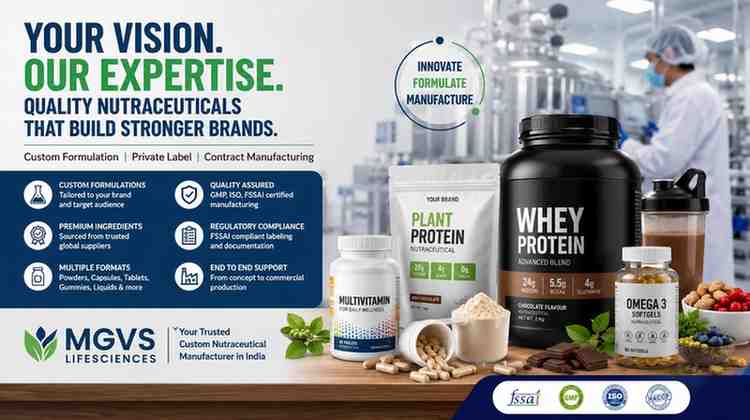
Companies such as MGVS Lifesciences support businesses across different manufacturing stages, including custom nutraceutical formulation, private label supplement manufacturing, contract manufacturing, third party manufacturing, sports nutrition manufacturing, and various dosage formats. Having these capabilities under one roof often makes product development more efficient, especially for brands planning multiple product launches.
How Custom Formulation Helps Your Supplement Brand Stand Out in a Competitive Market
The supplement industry continues to grow every year, but so does the number of competing brands. Simply launching another protein powder or multivitamin is rarely enough to build customer loyalty. This is exactly where a custom nutraceutical manufacturer creates long term value.
Custom formulation allows brands to solve specific customer problems instead of offering generic products. A sports nutrition company may develop a whey protein enriched with digestive enzymes for better absorption. A women's wellness brand may combine collagen, biotin, and essential vitamins into a single formulation. A healthcare practitioner may prefer evidence based ingredients at clinically relevant dosages instead of marketing driven combinations.
These differences may appear small on paper, yet they often become the reason a customer chooses one brand over another.
Ingredient flexibility is another major advantage. Businesses can select branded raw materials, plant based ingredients, clean label options, natural sweeteners, sugar free systems, or vegan formulations depending on their target audience. This level of control is difficult to achieve with standard ready made products.
Packaging also contributes to product positioning. Premium jars, stand up pouches, stick packs, travel sachets, and single serving formats all create different customer experiences. A custom nutraceutical manufacturer helps brands choose packaging that aligns with product stability, logistics, and market expectations rather than focusing only on appearance.
Earlier, we discussed how MOQ often influences manufacturing decisions. It certainly matters because inventory affects cash flow, especially for startups. However, after working with growing supplement brands, I have seen situations where formulation quality, consistent manufacturing, and customer retention become much more valuable than saving a little on production volume. The cheapest manufacturing option is not always the most profitable one.
One area that new brands often overlook is flavour validation. A technically excellent formulation may still fail if customers dislike its taste or texture. I still remember seeing cartons stacked in a warehouse during peak summer.
Pilot batches and product sampling help identify these issues before commercial production begins. Gathering feedback from gym members, nutrition consultants, distributors, or existing customers allows brands to refine the product before investing in large scale manufacturing.
Custom formulation also makes future expansion easier. Once customers trust a brand's flagship product, introducing complementary supplements such as creatine, BCAA alternatives, pre workout formulas, multivitamins, probiotics, capsules, tablets, or herbal nutraceuticals becomes much simpler because the brand identity is already established.
Manufacturers like MGVS Lifesciences work closely with businesses that want more than contract production. By combining formulation expertise, quality focused manufacturing, regulatory understanding, and scalable production capabilities, they help brands develop products that are built for long term growth instead of short term market entry.
Brands often spend months perfecting marketing but choose the wrong manufacturing partner in a single meeting. That decision usually affects everything that follows, from product consistency to customer reviews, repeat purchases, and business reputation. Before comparing quotations, it is worth asking a simple question. Will this manufacturer still be the right partner when your product line grows from one supplement to twenty?
Choosing the Right Ingredients, Dosages, Flavours, and Delivery Formats for Your Target Customers
A successful supplement is rarely built around a trendy ingredient alone. It succeeds because every element of the product is planned with the end customer in mind. This is where working with a custom nutraceutical manufacturer becomes far more valuable than simply selecting a ready made formula.
The first question should never be, "Which ingredient is popular?" Instead, it should be, "Who is going to buy this product?" The answer changes everything.
A gym focused brand may require high protein content, fast mixing, and bold flavours. A doctor developed supplement line may prioritise clinically supported ingredients and precise dosages. A wellness brand targeting working professionals may prefer clean label formulations with plant based ingredients and convenient single serving sachets.
Choosing ingredients is not just about adding more actives to the label. Some ingredients complement each other, while others reduce stability or affect taste when combined in the wrong proportions. A formulation containing probiotics, herbal extracts, vitamins, and minerals requires careful balancing to maintain effectiveness throughout the product's shelf life.
Dosage decisions also need practical thinking. Many startups request the highest possible ingredient levels because they believe bigger numbers sell better. That approach is not always appropriate. Dosages should align with regulatory guidelines, formulation objectives, scientific evidence, and consumer expectations rather than marketing alone.
Flavour development deserves more attention than many entrepreneurs realise. Consumers may appreciate a strong formulation once, but they will only purchase again if the product is enjoyable to consume. Chocolate, mango, coffee, vanilla, fruit punch, and cookies and cream remain popular choices, yet every flavour behaves differently depending on protein sources, botanical extracts, sweeteners, and processing methods.
A small pilot batch often saves significant costs later. It gives brands the opportunity to evaluate taste, aroma, mixability, colour, and mouthfeel before full scale production begins.
The delivery format is equally important. Different consumers have different preferences.
Product Goal
Recommended Format
Sports Nutrition
Powder in jars or pouches
Daily Multivitamins
Tablets or capsules
Kids Nutrition
Gummies or oral liquids
Herbal Wellness
Capsules, powders, or syrups
On the Go Consumers
Stick packs or sachets
Premium Clinical Products
Blister packed capsules or tablets
An experienced custom nutraceutical manufacturer helps businesses select the format that balances consumer convenience, manufacturing feasibility, product stability, and commercial viability.
Businesses working with MGVS Lifesciences can also explore multiple manufacturing categories including Private Label Supplement Manufacturing, Whey Protein Manufacturing, Mass Gainer Manufacturing, Creatine Manufacturing, Pre Workout Manufacturing, Capsule Manufacturing, Tablet Manufacturing, Liquid Supplement Manufacturing, Sports Nutrition Manufacturing, and Custom Nutraceutical Formulation. Having these capabilities available from one manufacturing partner makes future product expansion much easier.
What Happens Inside the Manufacturing Process Before Your Product Reaches the Market?
Many people only see the finished supplement sitting on a store shelf. They rarely see the planning, testing, documentation, and quality checks that happen before a single container is packed.
Every reputable custom nutraceutical manufacturer follows a structured production workflow designed to maintain consistency from batch to batch.
The journey usually starts with raw material procurement. Manufacturers source ingredients only from approved vendors who provide Certificates of Analysis and supporting quality documentation. Incoming materials are quarantined until quality teams complete verification.
Once approved, ingredients move to dispensing, where every raw material is weighed according to the approved Batch Manufacturing Record. Accuracy at this stage is essential because even small variations can affect the finished formulation.
The next stage is blending. Uniform mixing ensures every scoop, capsule, or tablet delivers consistent nutrition. Powder products require specialised blending equipment to achieve homogeneity, particularly when ingredients have different particle sizes.
Depending on the dosage form, the manufacturing process then moves into compression, encapsulation, granulation, liquid filling, or powder filling.
During production, quality personnel continuously monitor important process parameters such as blend uniformity, tablet hardness, capsule weight variation, moisture content, and fill accuracy.
Finished products are then transferred to packaging lines where automated systems fill containers, seal jars, apply induction seals, place desiccants where required, print batch numbers, and apply labels.
Packaging may look straightforward, but it plays a major role in maintaining product quality. Poor sealing or unsuitable packaging materials can expose supplements to moisture and oxygen, reducing stability over time.
Warehouse management is another part of manufacturing that often receives little attention. Products should be stored under suitable environmental conditions before dispatch to distributors or customers.
I still remember seeing cartons stacked in a warehouse during peak summer. It made me think about how much effort goes into developing a quality supplement, only for storage conditions to become an afterthought.
Reliable manufacturers document every production stage so complete batch traceability is maintained. If any issue arises later, the entire production history can be reviewed.
This systematic approach is why businesses prefer experienced companies like MGVS Lifesciences, where manufacturing is supported by documented processes instead of guesswork.
Certifications, Quality Testing, Regulatory Compliance, and Packaging Standards You Should Never Ignore
When comparing manufacturers, many businesses immediately ask about pricing. A better question is whether the manufacturer follows recognised quality systems.
An experienced custom nutraceutical manufacturer understands that certifications are not simply certificates displayed in the reception area. They represent systems that influence production quality every day.
Some of the most important standards include:
Area
Why It Matters
FSSAI Compliance
Legal manufacturing and food safety requirements
GMP Practices
Consistent production and hygiene standards
ISO Quality Systems
Standardised quality management processes
HACCP Principles
Prevents contamination during production
Batch Traceability
Allows tracking from raw material to finished product
Quality testing begins long before manufacturing starts.
Raw materials are evaluated for identity, purity, microbial contamination, moisture levels, and other relevant specifications.
During manufacturing, in process inspections verify that production remains within approved parameters.
Finished products may undergo testing for protein content, vitamin assay, microbial limits, heavy metals, dissolution, disintegration, and stability depending on the product category.
Labelling compliance is another area where many startups struggle.
A compliant label generally includes ingredient declarations, nutritional information, recommended serving size, storage instructions, allergen declarations where applicable, batch details, manufacturing and expiry dates, FSSAI licence information, and mandatory regulatory statements.
Incorrect labels can delay product launches even after manufacturing has been completed.
Export businesses often face additional documentation requirements depending on the destination country. Planning those requirements during product development avoids unnecessary shipment delays.
Choosing a custom nutraceutical manufacturer with established regulatory experience helps businesses avoid many of these complications before products reach the market.
What Affects Cost, MOQ, Lead Time, and Product Quality When Working With a Custom Nutraceutical Manufacturer?
One quotation rarely tells the complete story.
The price offered by a custom nutraceutical manufacturer depends on many interconnected factors rather than manufacturing alone.
Some of the biggest cost drivers include:
Ingredient quality and sourcing
Branded or patented ingredients
Imported raw materials
Product complexity
Flavour development
Packaging selection
Order quantity
Testing requirements
Special processing techniques
MOQ, or Minimum Order Quantity, is often one of the first topics discussed between manufacturers and startups.
Earlier, we talked about why MOQ is important because it directly affects investment, warehousing, and inventory planning. Small businesses naturally want lower production quantities while manufacturers need efficient production runs.
However, there are situations where focusing only on MOQ becomes a mistake. A slightly higher MOQ from an experienced manufacturer offering consistent quality, better testing, and stronger regulatory support may prove more profitable over the long term than selecting the cheapest production option.
Lead time also varies based on formulation complexity.
A standard formulation with readily available ingredients may move into production relatively quickly.
A customised formulation requiring imported ingredients, flavour development, packaging approvals, artwork revisions, and stability evaluations will naturally require more planning.
Businesses should also consider hidden costs such as redesigning labels, changing packaging suppliers, reformulating products after customer complaints, or replacing poor quality batches.
Sometimes saving money during manufacturing creates larger expenses after the product reaches the market.
A transparent custom nutraceutical manufacturer explains these factors before production begins, allowing brands to make informed commercial decisions instead of comparing quotations alone.
Common Mistakes Businesses Make While Selecting a Custom Nutraceutical Manufacturer
Many entrepreneurs invest heavily in branding, social media, influencer marketing, and ecommerce stores before finalising their manufacturing partner.
Ironically, the product itself often receives the least attention.
One common mistake is selecting a manufacturer purely because they offer the lowest quotation. Manufacturing costs certainly matter, but consistent quality, technical expertise, documentation, and regulatory support usually create greater long term value.
Another mistake is ignoring formulation discussions. Some businesses simply request a copy of an existing product already available in the market. While this may speed up launch timelines, it becomes difficult to build brand differentiation later.
Poor communication also creates unnecessary delays. Finalising artwork late, changing flavours after production planning, or repeatedly modifying ingredient lists can push launch schedules back by several weeks.
Businesses should also ask practical questions before signing any agreement.
Who develops the formulation?
How are raw materials verified?
What testing is included?
What certifications does the facility maintain?
Can production scale as the brand grows?
Is regulatory guidance available?
What support is offered after manufacturing?
I might be wrong here, but this does not apply to every manufacturer. Some companies specialise in high volume production, while others work closely with startups that require technical guidance throughout product development.
One awkward thing I have noticed is this. People spend hours comparing label colours but only minutes discussing manufacturing capability.
Businesses planning long term growth should choose a custom nutraceutical manufacturer that can support future product categories as well. Whether the next launch involves whey protein, collagen, creatine, herbal supplements, gummies, tablets, capsules, or liquid nutraceuticals, having one experienced manufacturing partner simplifies expansion considerably.
This is where MGVS Lifesciences focuses on building lasting partnerships rather than processing one time manufacturing orders. From custom formulations and quality focused production to private label manufacturing, contract manufacturing, and third party manufacturing, the objective is to help brands launch products they can confidently grow for years instead of just getting them manufactured quickly.
Why MGVS Lifesciences Is a Trusted Custom Nutraceutical Manufacturer for Growing Supplement Brands
Finding a manufacturing partner is easy. Finding one that understands your business goals is much harder.
Many companies can manufacture supplements, but not every custom nutraceutical manufacturer invests time in understanding who your customers are, how your products will be positioned, and what challenges you may face after launch. That difference becomes obvious once production begins.
At MGVS Lifesciences, manufacturing is approached as a long term partnership rather than a single production order. Whether someone is launching their first supplement brand or expanding an established portfolio, the focus remains on developing products that are commercially practical, compliant, and consistent in quality.
The journey usually starts with understanding the product idea. Some clients already know exactly what they want, while others only have a rough concept. A fitness coach may want to launch a premium whey protein. A doctor might be planning a clinical nutrition range. A wellness startup could be looking for herbal capsules or immunity supplements. Every project requires a slightly different approach.
As an experienced custom nutraceutical manufacturer, MGVS Lifesciences supports businesses through multiple stages of product development, including formulation planning, ingredient selection, flavour development, packaging guidance, manufacturing, quality testing, and regulatory documentation. Having these services available under one roof reduces coordination challenges and helps brands move from concept to commercial production more efficiently.
The company manufactures a wide range of nutraceutical products, including:
Whey Protein Supplements
Mass Gainers
Pre Workout Supplements
Creatine Products
Protein Powders
Multivitamins
Capsules
Tablets
Gummies
Liquid Supplements
Herbal Nutraceuticals
Sports Nutrition Products
Custom Formulations
Private Label Supplements
Businesses looking to build their own supplement identity can also benefit from services such as Private Label Supplement Manufacturing, Third Party Manufacturing, Contract Manufacturing, Sports Nutrition Manufacturing, and Custom Nutraceutical Formulation.
Quality remains one of the biggest priorities throughout the manufacturing process. Raw materials are sourced from approved suppliers, production follows documented manufacturing practices, and quality checks are carried out at different stages before finished products are dispatched. This helps maintain consistency across production batches, which is especially important for brands planning long term growth.
Another strength of working with MGVS Lifesciences is scalability. Many supplement companies begin with one or two products before gradually expanding into larger portfolios. Having a manufacturing partner capable of supporting that growth avoids the need to repeatedly change suppliers as the business evolves.
Regulatory support is equally important. Labelling requirements, FSSAI compliance, batch documentation, and packaging standards can often become confusing for first time entrepreneurs. Guidance during these stages helps businesses avoid unnecessary delays before launch.
One thing that experienced entrepreneurs eventually realise is that manufacturing is not simply about making products. It is about protecting a brand's reputation.
If customers receive consistent quality every time they order, trust begins to grow naturally. If product quality varies between batches, no amount of marketing can completely repair that damage.
That is why choosing an experienced custom nutraceutical manufacturer should be viewed as a business investment rather than a purchasing decision.
Before making your final choice, ask yourself one practical question.
Will this manufacturer still be able to support your business when your catalogue grows from one product to ten?
If the answer is yes, you have probably found a manufacturing partner worth building a relationship with.
Frequently Asked Questions About Custom Nutraceutical Manufacturer
What is a custom nutraceutical manufacturer?
A custom nutraceutical manufacturer develops and manufactures dietary supplements based on a brand's specific requirements instead of offering only standard ready made formulations. Services may include formulation development, ingredient sourcing, manufacturing, testing, packaging, and regulatory support.
Who should work with a custom nutraceutical manufacturer?
Startups, healthcare professionals, gym owners, nutritionists, wellness brands, pharmaceutical companies, exporters, distributors, ecommerce businesses, and sports nutrition brands often choose custom manufacturing to launch products under their own brand name.
Can I create my own supplement formula?
Yes. Most experienced manufacturers help businesses develop customised formulations based on product goals, ingredient preferences, dosage requirements, target customers, and applicable regulatory guidelines.
What is the minimum order quantity for custom manufacturing?
Minimum order quantity varies depending on the product type, packaging format, formulation complexity, and manufacturing process. Powder products, capsules, tablets, and gummies may each have different MOQ requirements.
How long does custom nutraceutical manufacturing usually take?
Production timelines depend on formulation development, raw material availability, flavour approval, packaging design, regulatory documentation, and production scheduling. A customised product generally takes longer than manufacturing an existing formulation.
What certifications should I look for before selecting a manufacturer?
Businesses should verify that the manufacturer follows applicable FSSAI requirements along with recognised quality systems such as GMP and relevant ISO standards. It is also worth asking about quality testing procedures and batch traceability.
Can a manufacturer help with private label supplements?
Yes. Companies such as MGVS Lifesciences provide Private Label Supplement Manufacturing alongside Custom Nutraceutical Formulation, Third Party Manufacturing, and Contract Manufacturing, allowing businesses to launch products under their own brand.
Does a custom formulation cost more than a ready made product?
In many cases, yes, because custom formulations involve research, ingredient selection, product development, validation, and additional testing. However, they also give brands greater product differentiation and long term market value.
Can I manufacture different dosage forms with the same manufacturer?
Most established manufacturers offer multiple dosage forms such as powders, capsules, tablets, gummies, sachets, and liquid supplements. Working with one manufacturing partner often makes future product expansion easier.
How do I choose the right custom nutraceutical manufacturer?
Look beyond pricing. Evaluate manufacturing experience, formulation expertise, quality systems, certifications, regulatory support, production capacity, communication, transparency, and the ability to scale with your business as it grows. The right manufacturing partner should be capable of supporting your brand long after your first product launch.